
Revolutionizing Learning: Harnessing Advantage-Based On-Policy Distillation for Intelligent Systems
As the field of artificial intelligence continues to advance, researchers are exploring innovative techniques to enhance the learning processes of intelligent systems. A recent paper by Mahdi Sabbaghi et al., titled When to Follow the Teacher: Advantage-Based On-Policy Distillation, introduces a pioneering method that could reshape how AI models learn from their teachers.
The Challenge of Standard Distillation
In traditional knowledge distillation, stronger models (teachers) guide weaker models (students) to improve their performance. However, conventional methods assume that any action recommended by the teacher will be beneficial for the student, which is often not the case. This can lead to inefficient learning as students may blindly follow teacher preferences that do not actually enhance their task performance.
Introducing Advantage-Based On-Policy Distillation (AOPD)
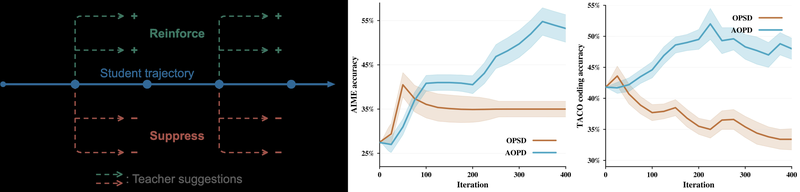
To tackle this issue, the researchers developed Advantage-Based On-Policy Distillation (AOPD). Unlike standard methods, AOPD evaluates and weights teacher actions based on their actual advantage or effectiveness for the current student. In simpler terms, AOPD prioritizes teacher guidance that genuinely contributes to the student's success, rather than simply following instructions blindly.
The Mechanics of AOPD
AOPD works by analyzing the potential outcomes of teacher actions on the current student’s performance. It reinforces actions that enhance expected rewards and downweights those that do not contribute positively. This is achieved without needing extra data or additional complexity in model training, allowing for streamlined learning processes.
Proven Efficiency Across Tasks
Experiments showcased in the study reveal that AOPD outperforms both traditional distillation methods and various reinforcement learning (RL) techniques in several domains, including mathematics, coding, and medical question answering. The model demonstrated significant improvements in external teacher settings and self-distillation scenarios, highlighting its versatility and efficiency.
Conclusion: A New Era for AI Learning
With the introduction of AOPD, researchers have opened the door to more effective teaching strategies for AI. By recognizing that not all teacher instructions yield beneficial outcomes, AOPD represents a significant step towards developing intelligent systems that learn more efficiently and effectively. This transformative approach not only enhances the learning potential of AI models but also sets the stage for continued innovations in AI education, ultimately contributing to smarter and more capable systems in various applications.
As the field progresses, strategies like AOPD could play a pivotal role in shaping how future AI systems are developed and refined, ensuring that they not only become smarter but also learn in a manner that is truly beneficial for their tasks.
Authors: Mahdi Sabbaghi, George Pappas, Hamed Hassani, Adel Javanmard


