
Revolutionizing Financial Safety: The Next-Gen Deep Learning System for Credit Risk Warnings!
In a stunning leap forward in the realm of financial technology, researchers from Washington University in St. Louis, Georgetown University, the University of Glasgow, and Wuyi University have unveiled a groundbreaking credit risk early warning system. This innovative system integrates diverse sources of data, enhancing the accuracy and timeliness of risk predictions through advanced deep learning techniques.
The Challenge of Traditional Risk Assessment
Traditional financial warning systems often grapple with inefficiencies caused by fragmented information and delayed response times. As they rely predominantly on static, rule-based engines, these systems can leave financial institutions vulnerable to unforeseen risks. Identifying and adapting to dynamic financial environments has been a serious hurdle for many, until now.
A Seamless Fusion of Heterogeneous Data
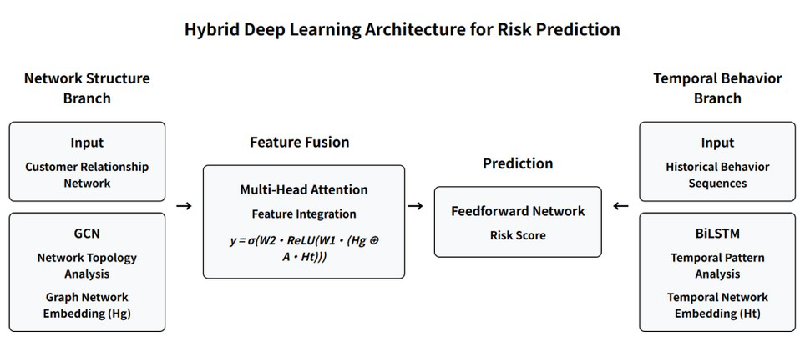
The research team's proposed solution adeptly tackles these issues by fusing multi-source heterogeneous data—from banking transactions and credit reports to social media interactions. Utilizing advanced deep neural networks complemented by attention mechanisms, the system meticulously extracts notable features from diverse data streams. This creates a robust mechanism for early identification of both corporate and individual credit risks.
Key Innovations: Real-Time Analytics at Its Finest
This new system architecture is structured in four interlinked layers, making it efficient and scalable. By employing cutting-edge technologies like Hadoop for large data processing and Kafka for real-time data transmission, the model is designed for millisecond-level risk assessments. Initial tests have shown this innovative framework offers predictions with up to 91.2% accuracy—effectively surpassing conventional models.
Outstanding Results: Performance That Speaks Volumes
In extensive system testing, the deep learning credit risk early warning system demonstrated exceptional capabilities, successfully predicting risks with a lightning-fast average response time of just 156 milliseconds. What's more, it outperformed traditional systems, offering a staggering 28-day lead time in risk identification compared to the industry average of just 7 days. These advancements not only enhance operational efficiency but also empower financial institutions with timely insights, potentially saving them from severe losses.
The Road Ahead: Future Enhancements
As the financial landscape continues to evolve, researchers are committed to further refining the system's capabilities. Future studies aim to incorporate privacy computing technologies for secure data sharing and to enhance the model's ability to discern low-probability, high-impact 'black swan' events, eventually paving the way for a more resilient financial risk management framework.
The implications of these findings extend beyond purely academic interest, offering practical tools that can help fortify the financial sector against risk, and ensure greater stability in an increasingly uncertain economic climate. As this innovative system finds its way into real-world applications, it stands to reshape the future of credit risk management.
In a world where financial stability is paramount, this next-gen early warning system could be the key to preventing disasters before they unfold.
Authors: LiYang Wang, Zhen Zhong, Zhen Tian, Keyu Chen




