
Revolutionizing Decentralized Learning: How Freshness-weighted Gossip Tackles Client Outages
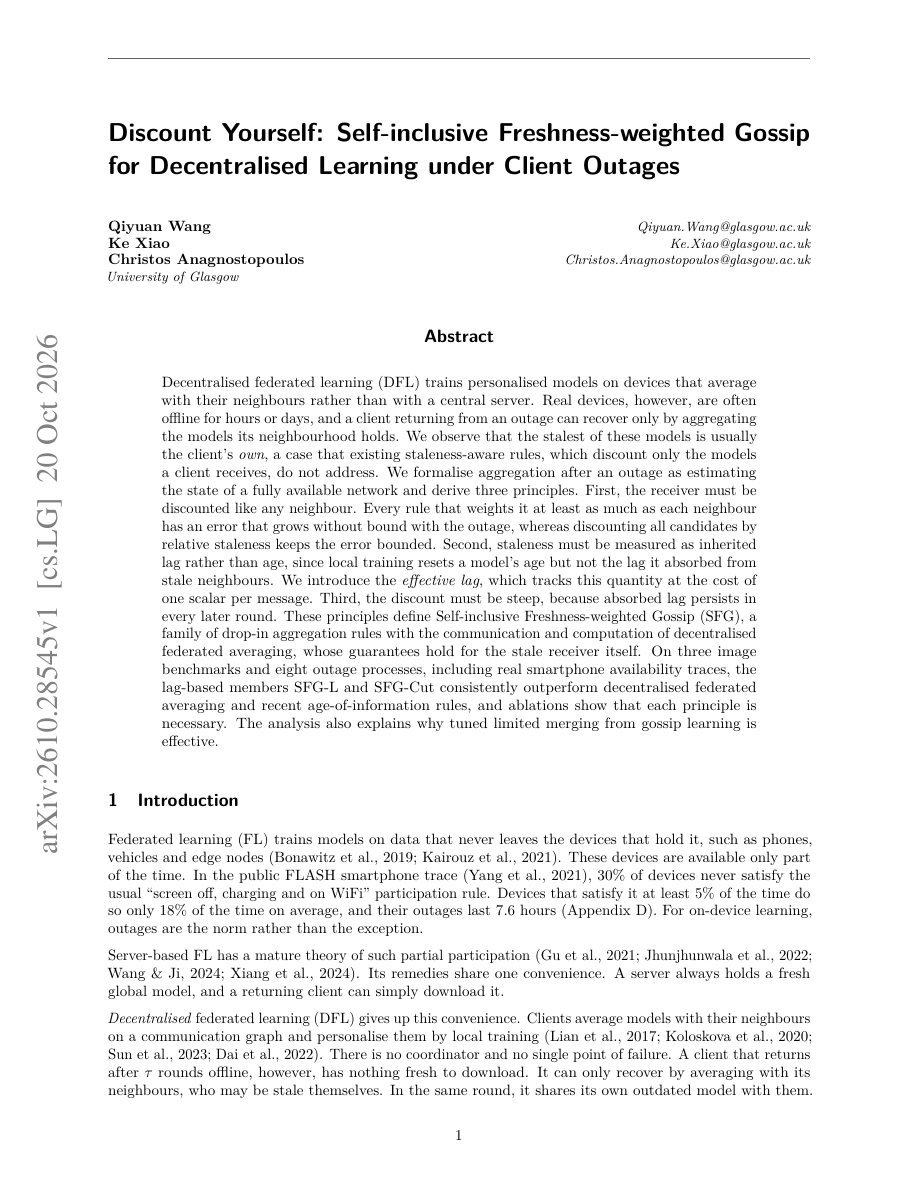
In an increasingly connected world, decentralized federated learning (DFL) is emerging as a powerful method for maintaining privacy while enabling machine learning on personal devices. However, client unavailability remains a daunting hurdle. Recent research from the University of Glasgow, titled "fDiscount Yourself: Self-inclusive Freshness-weighted Gossip for Decentralized Learning under Client Outages," uncovers innovative strategies to enhance DFL reliability in the face of client outages.
The Challenge of Client Outages
In federated learning, personalized models are trained on devices that communicate primarily with their neighbors instead of relying on a central server. Real-world conditions, however, often mean that many devices go offline for extended periods—sometimes days at a time. When a client returns, it frequently finds its own model is the oldest or "stale" model among its neighbors, leading to significant recovery challenges. Traditional aggregation methods do not adequately account for this scenario, often resulting in increasingly inaccurate models as older data is improperly weighted in the aggregation process.
Introducing Self-inclusive Freshness-weighted Gossip (SFG)
The researchers propose a new aggregation method called Self-inclusive Freshness-weighted Gossip (SFG) that fundamentally changes how models are weighted during recovery after an outage. The SFG method introduces three core principles:
- Discount Yourself: Each model, including the returning client's staleness, should be discounted based on its age and the freshness relative to the newest model in the neighborhood, keeping errors in check.
- Measure Inherited Staleness: Instead of measuring how long a model has been since its last training (its "age"), the aggregation process should consider the lag inherited from models averaged in the past.
- Discount Steeply: The discount must be more pronounced than typical aggregation rules suggest since some inherited staleness persists across multiple rounds.
Experimental Findings
The researchers conducted extensive tests on various datasets, including CIFAR-10 and FEMNIST, under different outage scenarios, ultimately showing that SFG outperformed traditional methods in nearly all settings. On average, SFG greatly improved personalized accuracy, especially under conditions where many clients were offline simultaneously. Particularly notable were gains exceeding 5 percentage points in accuracy compared to existing methods, such as age-of-information (AoI) enhancements.
One standout method, SFG-Cut, achieved impressive results by maintaining tighter margins on model selection, which is crucial for efficiency when clients are frequently unavailable. In fact, SFG-Cut closed approximately 56–60% of the gap in accuracy lost due to client unavailability, showcasing its potential as an effective solution to a pressing issue in decentralized learning.
A Broader Implication
The implications of this research extend beyond just improving accuracy in decentralized learning systems. By effectively addressing issues of data staleness and client outages, SFG paves the way for more robust and reliable machine learning applications in real-world environments, facilitating a wider adoption of decentralized methods across various industries where client privacy and data sensitivity are paramount.
As the landscape of machine learning continues to evolve, the strategies developed in this research signal a significant step towards more adaptive, resilient, and decentralized approaches to learning in privacy-sensitive contexts.
Authors: {Qiyuan Wang, Ke Xiao, Christos Anagnostopoulos}


