
Revolutionizing Crowd Monitoring: How Location-Unaware Robots Model Spatial Fields!
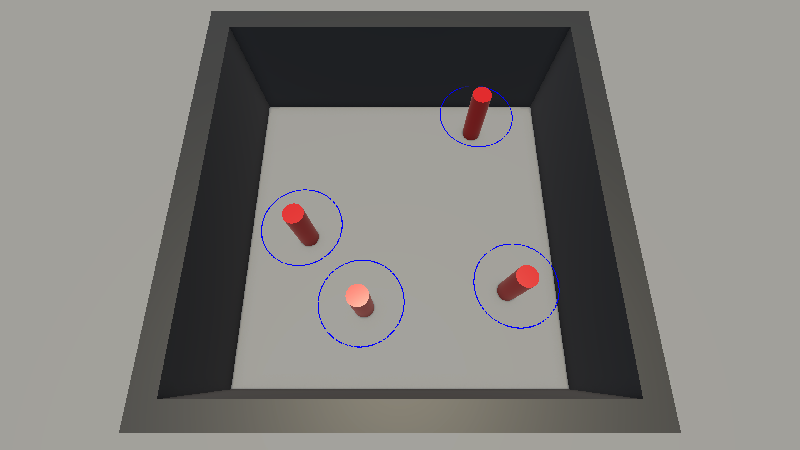
In an era where technology is steadily advancing, a new study has emerged that could revolutionize our understanding of spatial field modelling using swarms of robots. The research, conducted by Guillermo Legarda Herranz and his colleagues, proposes an innovative method called Location-Unaware Gaussian Process Regression (LU-GPR), which enables robots to operate effectively without relying on GPS systems.
The Challenge of Traditional Robotics
Robot swarms offer exciting potential in modeling complex spatial fields such as wind patterns, terrain elevation, or even crowd dynamics. However, traditional approaches often rely on external positioning systems to ensure the robots know their location. These methods pose limitations, especially in GPS-denied environments or situations where precise positioning is prohibitive.
Introducing LU-GPR: A Game Changer!
LU-GPR addresses these challenges by allowing individual robots to infer spatial fields using local measurements and communication with peers, eliminating the need for any external positioning. This innovative approach enables the robots to collectively agree on a common frame of reference as they work together to model their environment based solely on their local observations.
How It Works: A Simplified Explanation
In practical terms, LU-GPR combines the concepts of Gaussian Process Regression (GPR) with Gaussian belief propagation (GBP). Each robot gathers data about its surroundings over time, sharing this information with fellow robots and continuously refining its estimates. The algorithm also adapts to changing environmental conditions, effectively 'forgetting' older, less relevant information while prioritizing newer measurements for accuracy.
Real-World Applications: From Evacuation Scenarios to Crowd Behavior
The researchers showcased LU-GPR's capabilities in two key scenarios: first, by modeling a synthetic spatial function and second, by simulating the dynamics of a crowd during an evacuation. In both cases, the robot swarms demonstrated impressive scalability and accuracy, highlighting how LU-GPR could assist in disaster response situations, enhance crowd management, and facilitate safer navigation in crowded settings.
The Future of Robotic Swarms
LU-GPR represents a significant leap forward in swarm robotics. By enabling location-unaware robots to proficiently collaborate and model complex spatial phenomena, this research opens up new avenues for real-world applications. The potential benefits range from improving public safety in crowded environments to enhancing exploration and mapping tasks in challenging terrains, all without needing costly positioning systems.
In summary, this exciting advancement in robotics not only illustrates the effectiveness of decentralized systems in overcoming traditional constraints, but also paves the way for a future where robotic swarms operate seamlessly in our everyday lives, taking autonomous actions to ensure safety and efficiency in public settings.




