
Revolutionizing Chemical Imaging: How Multi-Contrast Wide-Field Mid-Infrared Microscopy Could Change the Game
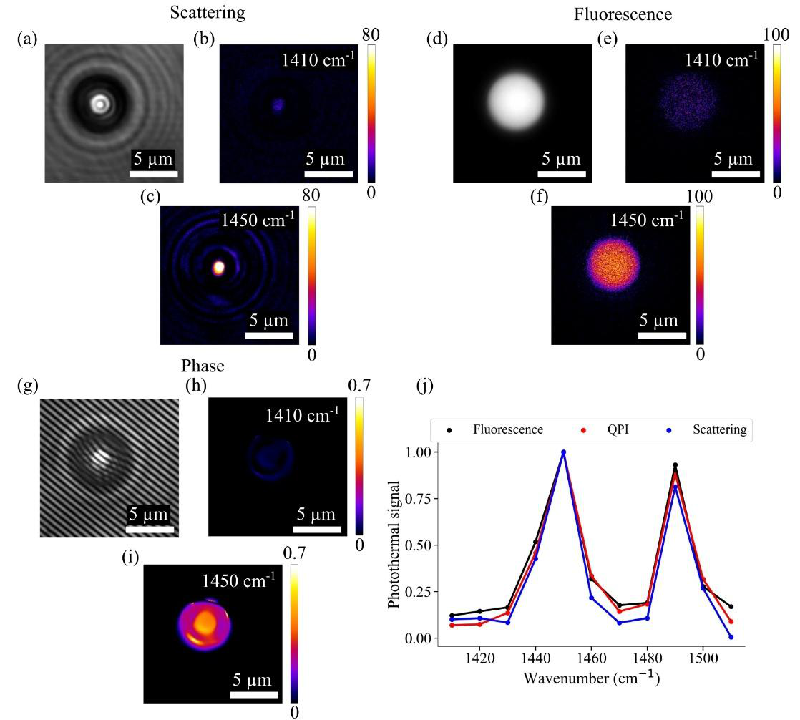
A groundbreaking research paper from a team at the Leibniz Institute of Photonic Technology unveils an innovative approach to mid-infrared (MIP) imaging that allows scientists to simultaneously exploit multiple contrast mechanisms in a single device. This new technology has the potential to streamline chemical imaging processes, making it more effective and accessible for research across biological and polymer samples.
What is Multi-Contrast Wide-Field MIP Imaging?
Mid-infrared photothermal imaging is a powerful technique that provides chemically specific images with resolution levels as fine as sub-micrometers. Traditional systems have generally been constrained to a single detection method—like scattering or fluorescence—each with its unique strengths and limitations. This new microscope, however, can switch between three different imaging modes: scattering, fluorescence modulation, and quantitative phase imaging (QPI), enhancing flexibility and accuracy in capturing detailed images of various samples.
Why is This Important?
The ability to choose between different imaging mechanisms significantly boosts the microscope's utility in diverse scientific applications. For instance, scattering-based detection offers a straightforward optical setup, while fluorescence provides higher sensitivity, and QPI excels in mapping optical path lengths. By integrating these modalities, researchers can tailor their imaging strategy based on specific sample properties or the desired outcome—reducing the need for multiple specialized instruments.
Key Findings of the Research
The authors conducted meticulous evaluations of the new microscope by testing its capabilities across various sample types including human cells, mouse lung tissue, and bacteria. The results demonstrated that:
- The effective spatial resolution of the microscope was measured to be as low as 376 nm for scattering and 429 nm for fluorescence, showcasing its impressive imaging capabilities.
- QPI demonstrated a significant advantage in signal-to-noise ratio (SNR)—up to 26 times higher than scattering—indicating its efficacy in extracting photothermal signals.
- Each contrast mechanism presented distinct trade-offs, allowing informed selection based on the nature of the sample being imaged.
Applications and Future Prospects
This switchable multi-contrast platform holds tremendous promise for a wide array of applications in both fundamental research and clinical diagnostics. It could revolutionize how scientists and clinicians visually analyze biological structures, providing insights previously hidden in traditional imaging approaches. The next steps include refining the technology for simultaneous multi-contrast acquisition, potentially enabling real-time imaging that seamlessly integrates different modalities.
Overall, the advancements in multi-contrast wide-field mid-infrared photothermal imaging are set to enhance our understanding of complex materials and biological systems, paving the way for new discoveries in fields ranging from medicine to materials science.
Authors: {ANOJ THAYYIL RAVEENDRAN, CORNELIA REUTER, SAMIR F. EL-MASHTOLY, JÜRGEN POPP, CHRISTOPH KRAFFT}




