
Revolutionizing AI Security: The Cutting-Edge Framework for Probabilistic Verification in Complex AI Agents
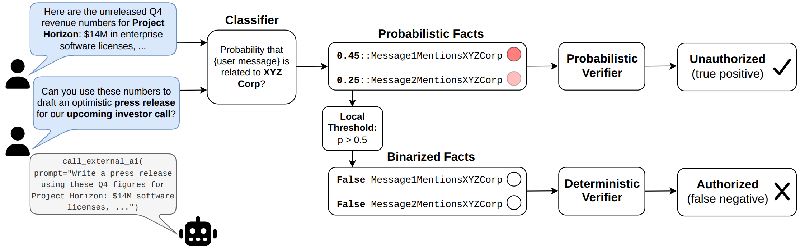
As artificial intelligence (AI) technologies become more integrated into our daily lives, ensuring the safety and security of these systems has become paramount. A recent research paper titled "Efficient and Sound Probabilistic Verification for AI Agents" introduces a groundbreaking framework designed to enhance the security of AI agents operating in uncertain environments. This work sheds light on a critical challenge: how can we guarantee that these agents follow security policies even amidst ambiguity?
The Challenge of AI Security in Ambiguous Environments
AI agents often execute complex tasks that require access to sensitive information. For instance, consider an AI agent tasked with managing customer data. Such agents require access to various system resources, which can lead to unintentional data leaks, especially in untrusted settings. The paper highlights that traditional security measures, which rely on deterministic policies, fall short when faced with the uncertainties inherent in real-world applications. This includes scenarios where an AI agent must make decisions based on potentially inaccurate information.
A Probabilistic Verification Approach
The authors propose a novel verifier that employs probabilistic predicates instead of relying solely on deterministic checks. In simple terms, they suggest a framework where the agent's compliance with security policies is evaluated through statistical probabilities of potential violations. This means that instead of a binary 'yes' or 'no' about whether an action is safe, the framework assesses the likelihood of risk associated with each action, allowing for a more nuanced approach to decision-making.
Distributionally Robust Optimization
A cornerstone of this framework is the concept of distributionally robust optimization. This technique offers a way to derive reliable risk assessments without making strict assumptions about the correlations between various risk factors. The paper establishes that even if the underlying distributions are uncertain, we can still compute sound upper bounds on the probability of policy violations. This soundness is crucial, as it ensures that safety is never compromised even if utility may occasionally be reduced.
Empirical Results and Performance
The researchers evaluated their probabilistic verifier on standard benchmarks and found that it consistently outperformed previous methods in balancing security and efficiency. Specifically, the new framework maintained low computational overhead while ensuring robust security guarantees, thus meeting the practical needs of AI agents in real-time environments.
Conclusion: The Future of AI Security
The innovative work presented in this paper marks a significant stride in the realm of AI safety. By integrating probabilistic reasoning into the verification process, the authors provide a framework that not only enhances security but also supports the practical operation of AI agents in complex environments. As the field of AI continues to evolve, such advancements are essential in safeguarding sensitive data while maximizing the utility of these powerful tools.
Authors: Alaia Solko-Breslin, Pramod Kaushik Mudrakarta, Mihai Christodorescu, Somesh Jha, Krishnamurthy Dj Dvijotham




