
Revealing Optimal Order: The Secret to Balancing Growth and Resilience in Multi-Agent Systems
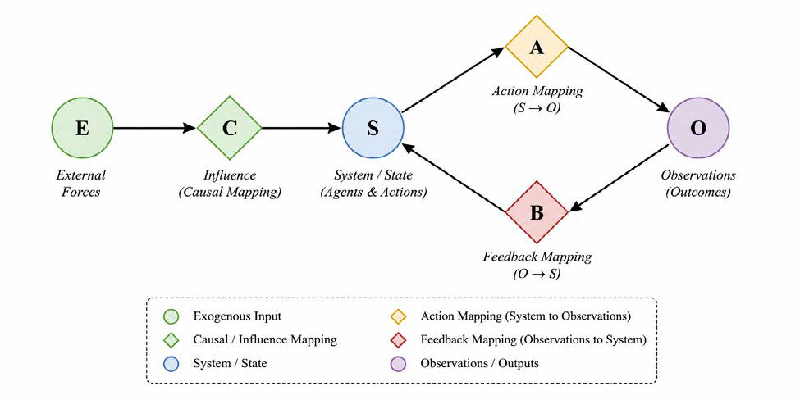
In a groundbreaking research paper, Jake J. Xia delves deep into the realm of multi-agent systems, providing a new framework to understand how these systems interact and evolve. This research sheds light on how agents—be they individuals, robots, or algorithms—communicate, influence, and adapt to the collective behaviors around them. Central to this analysis are two fundamental variables: the power an agent holds and their response functions to observations.
Understanding Multi-Agent Systems
Multi-agent systems are collections of autonomous entities that work together to achieve complex tasks. From social networks to financial markets and even neural networks in our brains, these systems exhibit behaviors that are not predictable by merely examining individual agents. Xia's research emphasizes the importance of feedback loops, which showcase how actions by one agent can significantly influence others, resulting in emergent collective behaviors.
Key Concepts: Power and Response Functions
The two core elements of Xia's framework are agent power and response functions. The power of an agent is defined by its influence over collective outcomes, while response functions dictate how agents react to their environment and the actions of other agents. Xia found that these dimensions are crucial in determining macroscopic properties such as stability, mobility, and productivity within these systems.
To illustrate this, consider a financial market where the decisions to buy or sell stocks are influenced by market trends. Each investor (agent) responds to observations of the market, and their collective decisions directly impact the market dynamics. This interplay complicates prediction models due to the intertwined nature of agent actions.
Balancing Growth and Resilience: The Optimal Order
One of the most significant findings in Xia's work is the concept of “optimal order.” The research posits that while stronger synchronization among agents can boost productivity, it may simultaneously increase systemic fragility. This fragility can lead to heightened risks during uncertain conditions. Thus, finding the sweet spot between too much coordination and too little is essential for a system's long-term success.
The paper introduces a utility function based on risk appetite, which helps define the ideal balance between productivity, stability, and adaptability. For instance, a system heavily focused on maximizing productivity could become vulnerable without the necessary resilience against shocks, such as economic downturns or unexpected events.
Implications and Applications
The implications of Xia's framework extend beyond theoretical understanding; it offers practical insights into managing complex systems in various fields. For example, in artificial intelligence, achieving an optimal balance of synchronization could enhance model performance by preventing rigidities that may emerge from excessive uniformity in decision-making.
Moreover, this research can be applied to societal systems, such as public opinion generation on social media, where a delicate balance between differing viewpoints and influential narratives can determine the health of democratic discourse.
Looking Ahead: Future Explorations
While Xia's framework opens new avenues for understanding multi-agent systems, it also raises critical questions for future research. How can agent response functions be empirically measured? What methodologies can be developed to identify optimal order in real-world scenarios? Addressing these questions could further enhance our understanding of complex adaptive systems and their dynamics.
In conclusion, Xia's research presents a novel lens through which we can observe and optimize multi-agent interactions, guiding both theoretical advancements and practical applications in diverse fields. By recognizing that the collective behavior emerges from the interplay of individual actions, we can more effectively steer complex systems towards resilience and productivity in an ever-adaptive landscape.
Authors: {Jake J. Xia}




