
Redefining Reranking: How System One Decisions Make Multimodal Retrieval Smarter
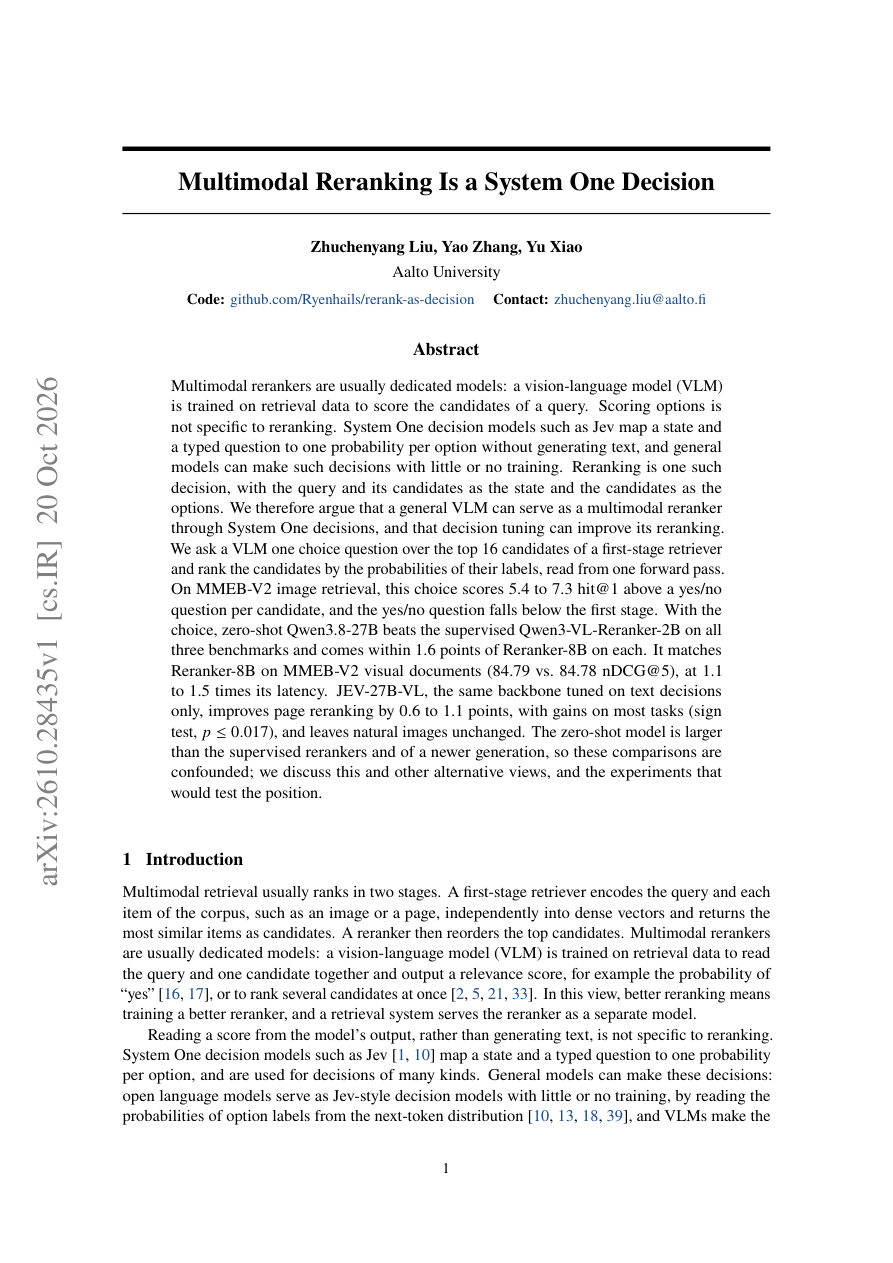
In a groundbreaking study published by researchers from Aalto University, a novel approach to multimodal reranking is introduced, promising to enhance the efficiency and performance of retrieval systems across a variety of benchmarks. The research showcases how a general vision-language model (VLM) can be utilized as a multimodal reranker using System One decisions—simplifying the reranking process while boosting accuracy.
Understanding Multimodal Reranking
Multimodal retrieval processes typically involve two stages: first, a retriever identifies and returns a set of potential candidates based on their relevance to a query. Next, a reranker assesses these candidates to determine their final order based on relevance. Historically, rerankers have been specialized models trained specifically for this task. However, Liu and colleagues propose that a general VLM can take on this role by making quick decisions, akin to how we intuitively respond to choices rather than carefully deliberating each one.
Introducing System One Decisions
The core of this innovative method hinges on what’s termed System One decision models. Instead of generating comprehensive answers or extensive evaluations, these systems generate probabilities for options in a single pass. In simple terms, rather than evaluating each candidate separately (which can be resource-intensive), the VLM evaluates all candidates at once and ranks them based on a single probability score derived from its output.
Key Findings of the Research
One of the significant findings of this study is that using a choice question format (e.g., "Which candidate best matches the query?") significantly outperforms traditional yes/no questioning methods when employed in multimodal retrieval. The research reveals that this choice format yields higher accuracy across various benchmarks, particularly in image retrieval tasks.
Moreover, the zero-shot VLM model (Qwen3.8-27B) demonstrated superior performance compared to dedicated rerankers like Qwen3-VL-Reranker-2B across multiple evaluation metrics, achieving scores between 5.4 to 7.3 points higher in hit rates.
Efficiency and Practical Implications
Not only does this new approach promise improved accuracy, but it is also more resource-efficient. By utilizing a single forward pass to make decisions on multiple candidates, the computational load is significantly reduced. This means that organizations with existing VLMs can adapt their systems without the need for a separate, specialized reranking model, which simplifies maintenance and updates.
Future Directions
The study opens up exciting avenues for further research, particularly in enhancing decision tuning methods to further improve reranking efficacy. As the authors note, there are numerous experiments yet to be conducted to validate these findings across different scales and modalities.
In conclusion, this research not only challenges the traditional landscape of multimodal retrieval but also provides a pathway towards more intelligent, efficient systems that can keep pace with the rapidly advancing field of artificial intelligence.
Authors: Zuchenyang Liu, Yao Zhang, Yu Xiao
Contact: zhuchenyang.liu@aalto.fi
For further reading, you can access the code at: github.com/Ryenhails/rerank-as-decision


