
Redefining Clustering Efficiency: How Uniform Sampling is Revolutionizing the k-Means Algorithm
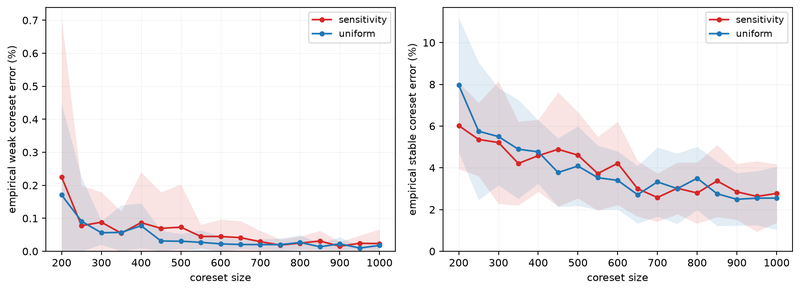
In a world increasingly driven by data, the efficiency of clustering algorithms has never been more critical. The recent paper by Amir Carmel and Robert Krauthgamer from the Weizmann Institute of Science, titled "fCoresets for k-Means: When Does Uniform Sampling Suffice?", reveals a groundbreaking approach to optimizing data clustering through uniform sampling.
The Importance of Coresets
Coresets, or core sets, are minimized representations of larger datasets that maintain essential properties, allowing for scalable solutions to clustering problems without needing to analyze the entire dataset. The authors focus particularly on uniform sampling—an incredibly simple and efficient method for constructing coresets in the context of the k-means problem. This holds significant implications as datasets continue to grow in size.
Understanding the k-Means Problem
At its core, the k-means algorithm seeks to partition a set of data points into k distinct clusters, with an emphasis on minimizing the distance between points and their assigned cluster center. The paper discusses weak, stable, and strong coresets derived from uniform sampling—each varying in their characteristics and suitability based on specific clustering objectives. The researchers particularly highlight how these notions differ significantly in sample complexity.
Key Findings and Contributions
The paper establishes that uniform sampling can yield a stable coreset for k-means clustering without the need for extensive computations associated with reading the entire input. Notably, it provides matching upper and lower bounds on the sample complexity for both weak and stable coresets, proving that the dependency on the dataset's dimension and size can be independent of achieving effective clustering results.
Applications and Impact
The results from this study suggest that uniform sampling is not just an alternative to traditional methods but rather a viable and effective approach for clustering on very large datasets. The authors’ experimentation shows that uniform sampling matches the accuracy of more complex sampling methods, despite requiring much less computation time. This breakthrough opens new possibilities for real-time data analysis and machine learning applications.
Conclusions
The work by Carmel and Krauthgamer emphasizes the importance of simplicity coupled with efficiency in data clustering methods. By leveraging uniform sampling to construct stable coresets, this research could significantly advance how we approach clustering in various fields, from artificial intelligence to data warehousing. As datasets grow larger and more complex, findings like these will be critical in ensuring that powerful analytical techniques remain accessible and efficient.
Authors: Amir Carmel, Robert Krauthgamer


