
Predicting West Nile Virus Spread: A Quantum Leap in Epidemic Modeling
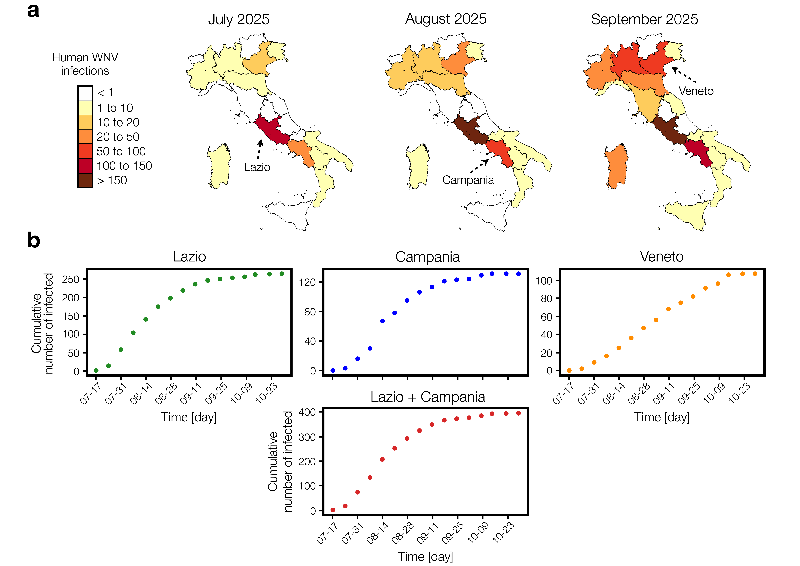
Recent research conducted by a team of scientists from Italy presents a groundbreaking approach to modeling the spread of West Nile virus (WNV) using a quantum version of the Game of Life, a well-known cellular automaton. This novel computational model offers insights into how environmental changes, like climate conditions, impact the dynamics of infectious diseases, potentially transforming how we understand and manage epidemics.
The Rise of West Nile Virus in Italy
The study highlights a marked increase in WNV infections across Italy in recent years, notably in the southern Lazio, Campania, and Veneto regions. The virus is primarily transmitted by Culex pipiens mosquitoes, which thrive in urban environments. As temperatures rise and humidity levels fluctuate due to climate change, the spread of these mosquitoes and the diseases they carry also intensifies.
The researchers aimed to model the epidemic’s spread during the summer of 2025 in an effort to better understand the factors contributing to the infections. Utilizing the generalized semi-classical Game of Life (gSCGOL), the scientists were able to simulate human and mosquito populations, capturing the intricate interactions that lead to disease transmission.
How Quantum Mechanics Enhances Modeling
At the heart of this research is the innovative application of quantum mechanics to the cellular automaton model. Traditional models rely on binary states—alive or dead—but by incorporating quantum states, the gSCGOL allows for a more nuanced simulation that captures the complexities of human mobility and mosquito interactions better than its classical counterparts.
By analyzing various ecological parameters, the researchers showed that their model could accurately predict the number of infections over time, allowing for a deeper understanding of the epidemic's behavior under different environmental scenarios. These insights are crucial for developing effective public health strategies.
Key Findings and Implications
The study found that the model effectively matched observed epidemiological data, revealing significant trends in WNV infections that correlate with environmental factors such as temperature and humidity. An increase in mosquito population was linked to rising temperatures, while a decrease in humidity had an observable negative impact on mosquito breeding, showcasing the delicate balance of ecological factors in disease spread.
Moreover, predictions based on the model could guide public health officials by illustrating potential outcomes based on changes in mosquito population control measures. By tweaking parameters within the gSCGOL framework, researchers can simulate the effects of various interventions, allowing decision-makers to strategize more effectively against vector-borne diseases.
Conclusion: A Tool for the Future
The researchers concluded that the gSCGOL model not only enhances the understanding of WNV dynamics but could also be adapted for other vector-borne diseases, such as dengue and Zika. As climate change continues to alter ecosystems and disease patterns, tools that can incorporate complex biological and environmental interactions will become increasingly essential in our fight against infectious diseases.
This research marks a significant step forward in epidemiological modeling, showcasing the potential of quantum computing to provide deeper insights into public health challenges.
Authors: Andrea Fontana, Simone Tambascia, Ciro Di Carluccio, Andrea Esposito, Bernardo Spagnolo, Andrea M. Chiariello




