
Pioneering Phononic Control: Unlocking Free-Electron Dynamics through Mechanical Sensing
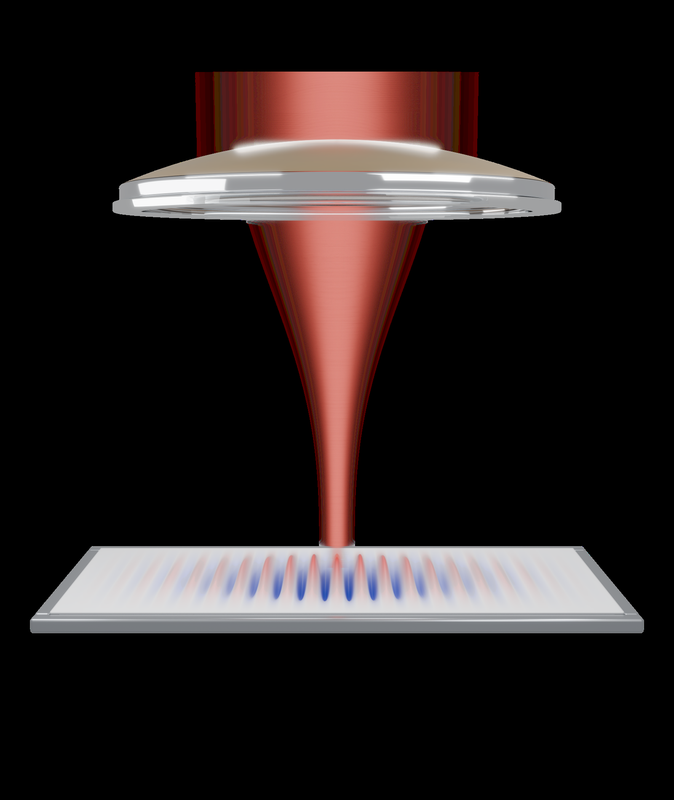
A groundbreaking research paper reveals how mechanical vibrations can be harnessed to control free-electron dynamics, offering a new paradigm for enhancing sensing technologies. By utilizing an optomechanical membrane, scientists have theoretically demonstrated a phonon-assisted interface that enables precise manipulation of free electrons, allowing for efficient sensing of localized forces.
The Core Insights
Mechanical vibrations play a significant role in various physical phenomena, and this research extends the understanding of their interaction with free electrons. The authors propose that by using an optomechanical membrane, they can scatter cavity light into high-momentum evanescent fields, which interact with electrons traveling through a vacuum. This interaction not only provides momentum for phase matching but also allows for the strength of the electron-light interaction to be tuned based on the mechanical vibrations.
The study indicates that external forces affecting the mechanical vibrations can be read out by analyzing the electron recoil spectrum. This approach enables higher sensitivity compared to traditional optical methods, setting the stage for advancements in precision measurements—an area that remains largely underexplored.
Mechanical Sensing: A New Frontier
The theoretical framework established in this work indicates that the mechanical vibrations can encode forces that act on the system. This forms a basis for mode-selective sensing, where specified mechanical vibrations can be excited based on the force profile applied locally. The implications are vast, as localized forcing techniques could lead to more efficient and sensitive mechanical sensing systems that outperform current optical readouts.
Comparative Analysis: Free-Electron vs. Optical Readout
A notable finding from the paper is the comparison between electron readout and traditional optical homodyne detection. The mechanically-driven electron interactions can maintain higher signal-to-noise ratios, particularly in scenarios where optical signals are weakly visible due to mechanical averaging effects. The electrons’ response is shown to be coherent and can capture its mechanical environment more efficiently than optical methods, especially in settings where the mechanical modes are not easily accessible.
Future Directions and Conclusion
This research lays the foundation for future experimental investigations that could utilize vibrating membranes for mechanical sensing and free-electron control. The authors hint at a roadmap leading toward practical implementations of such systems in various fields, from nanotechnology to quantum computing.
The potential for mechanical control in free-electron optics presents an innovative avenue for advancing measurement techniques in intricate physical systems. As research progresses, the findings may lead to breakthrough technologies in sensing, imaging, and information transfer within complex environments.
In summary, this paper opens up new horizons in the interplay between mechanical vibrations and free-electron dynamics, promising enhanced capabilities for precise measurements and forcing scenarios.
Authors: {Sunjun Hwang, Lee Wei Wesley Wong, Liang Jie Wong, Leong Chuan Kwek}


