
Pioneering Green Computing: Pre-emptive Carbon-Aware Scheduling Revolutionizes Edge Workloads
As the race to combat climate change intensifies, a groundbreaking new study offers insights into how we can restructure computing systems to be more environmentally friendly. Conducted by researchers Cecilia Chen, Rajni Dabas, Samir Khuller, and Emilie Rivkin, this research introduces a unique framework for pre-emptive carbon-aware scheduling in edge computing, aiming to balance computational demands with the varying carbon intensity of energy sources.
The Challenge of Carbon Intensity
Modern power grids predominantly rely on a mix of fossil fuels and renewable energy sources, leading to fluctuating carbon emissions based on the time of day and location. This inherently creates opportunities for reducing the carbon footprint of computing tasks by strategically shifting workloads to moments when renewable energy is abundant.
The complexity arises from the need to meet specific deadlines and task dependencies while taking advantage of these cleaner time slots for processing jobs. The researchers focus on effectively managing these challenges through innovative scheduling algorithms that prioritize carbon reduction without compromising performance.
Innovative Solutions for Edge and Cloud Computing
The researchers developed a model that operates between edge servers—where processing is quick and inexpensive—and cloud servers, which offer extensive computational resources at a higher operational cost. The study identifies two key decisions for scheduling: where to execute a job (locally on the edge or remotely in the cloud) and when to run it.
By utilizing a preemptive scheduling approach, jobs can be paused and resumed to align processing with lower carbon intensity periods. This is particularly beneficial for applications that can afford some delay, allowing for significant reductions in overall emissions.
The Results: Efficiency Meets Sustainability
The research presents a polynomial-time algorithm that optimally schedules jobs on a single edge server and highlights the challenges introduced when considering cloud outsourcing, which can complicate the scheduling complexity to NP-hard levels. For the cloud scheduling scenarios, the researchers achieved a Fully Polynomial Time Approximation Scheme (FPTAS), demonstrating a feasible approach to balancing cost and environmental impact.
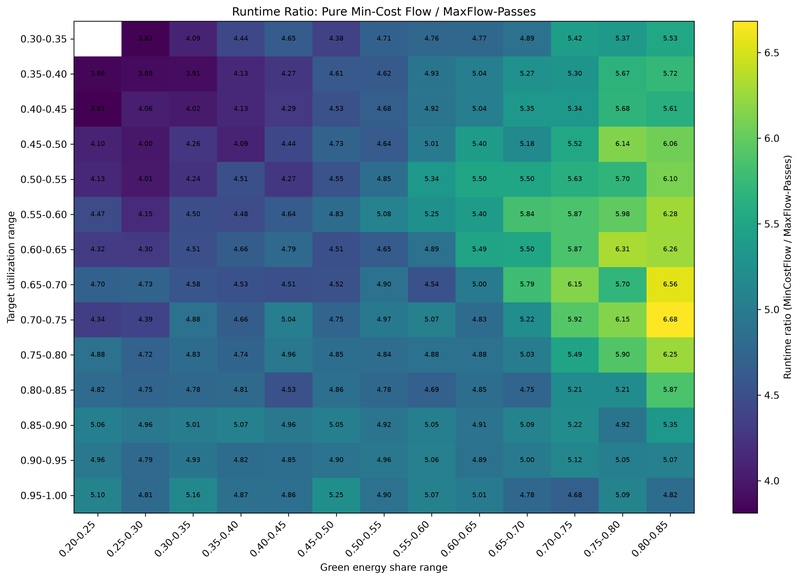
Through extensive experimentation using both synthetic workloads and real-world data from Alibaba, the study reveals that their proposed scheduling strategy significantly outperforms traditional methods, sometimes offering computational advantages that are nearly five times faster. These findings suggest that carbon-aware scheduling could be a game changer for future computing systems, significantly lowering their ecological impact.
Implications for Future Technologies
This research underscores the necessity for a paradigm shift in how we approach computing resource management, highlighting that sustainability and efficiency can indeed coexist. As data-heavy applications continue to grow, the adoption of carbon-aware scheduling techniques could not only align with global sustainability goals but also enhance the resilience and efficiency of computing infrastructure. The potential for integrating such strategies into standard practices presents a compelling case for stakeholders in the technology sector to reevaluate their operational strategies.
By prioritizing carbon reduction in scheduling practices, industries can take a significant step toward greener technology solutions in a world increasingly influenced by climate change.


