
Meet FlashVector: The AI Agent That Supercharges Model Efficiency with Game-Changing Optimizations!
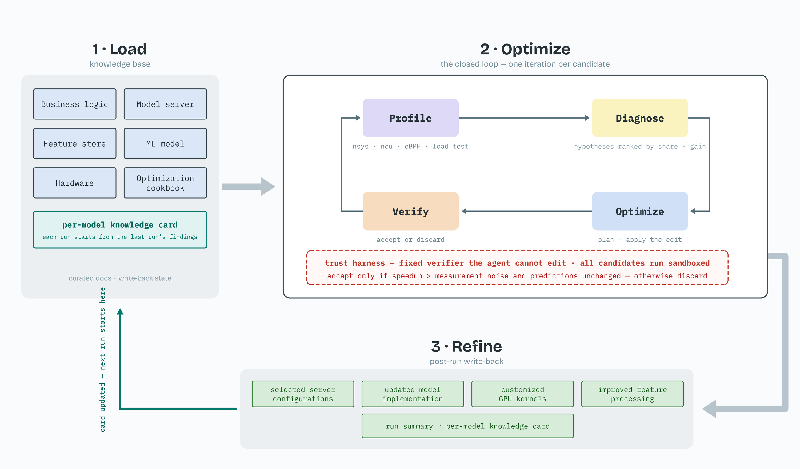
In a world driven by data and machine learning, model serving is often a significant operational cost for businesses utilizing recommender systems. A recent paper introduces FlashVector, a novel AI Agent that optimizes the entire model serving stack—from GPU kernels to feature processing—resulting in unprecedented increases in efficiency.
The Challenge of Model Serving
Modern recommender systems rely heavily on deep learning models, which function at scale and handle thousands of inference requests every second. However, optimizing these models is no small feat. Each layer of the model serving stack—ranging from GPU execution to processing features—requires specialized knowledge to navigate effectively. As the technology landscape continues to evolve, many organizations struggle to optimize their systems cohesively, leading to inefficiencies and increased costs.
Introducing FlashVector: A Breakthrough in Efficiency
FlashVector offers a groundbreaking solution by providing a unified framework for optimizing all layers of the model serving stack. Unlike existing methods that fixate on individual segments, FlashVector employs a profile-diagnose-optimize-verify loop that works harmoniously across various programming languages and technologies. This holistic approach allows it to identify and rectify performance bottlenecks across the entire architecture, thus unlocking efficiency gains of up to 2× throughput and 1.98× latency reduction.
How FlashVector Works
The innovation of FlashVector resides in its ability to plug every serving layer into the same optimization cycle. Each layer conforms to a standard optimization interface, making it easier to tackle challenges like:
- Identifying performance bottlenecks using specialized profiling tools.
- Implementing proposed improvements in a fault-tolerant manner.
- Continuously refining previous findings to maintain efficiency as conditions change.
This method ensures that every optimization is validated against real production traffic before being applied, facilitating reliable long-term improvements.
Real-World Impact: Achievements and Case Studies
Deployed within Unity’s Vector advertising platform, FlashVector has already transformed how the platform operates. It has been shown to:
- Discover unusual optimization opportunities in GPU kernels and feature processing.
- Enhance model inference efficiency by up to 30× on some processing steps.
- Effectively tune serving stack parameters to maintain optimal performance.
Through iterative case studies, significant performance boosts have been achieved, illustrating the capability of FlashVector to adapt to shifting workloads and conditions in real time.
What's Next for FlashVector?
As FlashVector continues to evolve, its implications for future AI systems are profound. The ability to not only optimize code but to do so continuously and autonomously paves the way for more sophisticated artificial intelligence frameworks. Such advancements promise to reduce operating costs further and improve overall system performance across various sectors.
In conclusion, FlashVector exemplifies the potential of AI-driven optimization to revolutionize complex system architectures, making significant strides towards a future where costs in model serving become manageable while maintaining peak operational efficiency.
Authors: Qi Wu, Lohan Lemire, Kai Meng, Zhongmou Cai, Raphael Bargues, Petr Zhitnikov, Zeyuan Cao, Yao Wang, Shujun Bian, Wei Chen, Sean Sheng




