
Mastering Code with Adaptive Skill Granularity: A New Era for Coding Agents
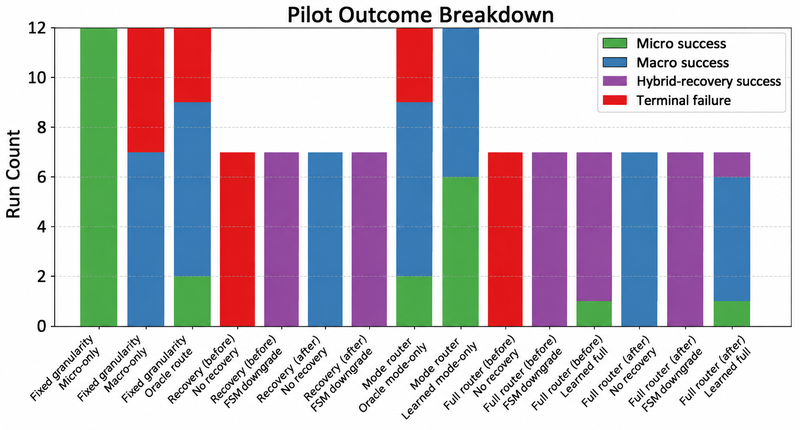
In the realm of artificial intelligence and software engineering, a revolutionary framework known as **Adaptive Skill Granularity** is making waves. Researchers Dingxuan Zhang, Yanhui Jiang, Jun Wang, and Hefeng Zhou have developed a sophisticated system designed to enhance the efficiency and reliability of coding agents through adaptable skill execution. This framework helps agents choose not just which skills to use, but also how to approach tasks at different levels of complexity—essentially controlling their "skill granularity" in real-time.
What is Adaptive Skill Granularity?
At its core, Adaptive Skill Granularity is about striking a balance between using high-level macro skills and low-level micro tools for executing tasks. For coding agents, this is particularly crucial because different programming tasks may require varying levels of abstraction—sometimes a simple edit suffices, while at other times, a larger module movement is necessary. The new framework allows agents to switch between these modes dynamically based on the current task requirements and execution state.
The Crucial Role of Runtime Control
This approach moves away from traditional static skill retrieval methods. Instead of simply selecting a skill based on a task description, agents must also determine the best way to execute that skill in real-time. For example, if a macro-level skill fails—such as when a complex operation doesn't yield the expected result—the agent can quickly revert to using more granular, micro-level tools to recover and continue working on the task. This ability to adapt not only enhances flexibility but also improves robustness in task execution.
Key Innovations of the Framework
The researchers introduce several key innovations through their Adaptive Skill Granularity framework:
- Dynamic Skill Granularity Control: Agents can adjust their operational mode based on the task's complexity, choosing from micro tools, macro skills, or a hybrid approach.
- Finite-State Recovery Executor: This component allows agents to seamlessly recover from macro failures by executing a fallback to micro tools, thus enhancing reliability.
- Verifier-Driven Evaluation: Success and efficiency are measured against a deterministic validation process, ensuring that the agents deliver verified outputs while minimizing execution costs.
Experimental Findings and Implications
The experiments conducted by the researchers revealed notable insights. While fixed granularity approaches (where agents either only use macro or only micro skills) showed clear weaknesses, adaptive methods significantly improved robustness and efficiency. Results indicated that the combination of learned mode routing and selective recovery led to higher success rates with reduced costs, demonstrating that dynamic execution strategies are more effective than static ones.
The researchers established a new protocol, GranBench-Code, to evaluate the performance of coding agents comprehensively, revealing that adaptive skill granularity could handle a diverse set of programming challenges with improved outcomes. This paradigm shift suggests that future coding agents could be more reliable and efficient, making strides in various software engineering tasks.
Looking Ahead
The implications of Adaptive Skill Granularity are profound. As AI continues to integrate more deeply into complex tasks like programming, the ability to adapt and recover in real-time will be crucial for developers and organizations. Striving for a more efficient and effective coding experience, this breakthrough sets the stage for further advancements in intelligent systems capable of managing multifaceted software engineering challenges.
As we witness this evolution in coding agents, one thing is clear: the future of AI-driven software development is not just about executing tasks but dynamically mastering the art of coding through adaptable strategies.
For those interested in the technical aspects, the research paper is available on GitHub, inviting further exploration into this exciting development in coding agents.
Authors: Dingxuan Zhang, Yanhui Jiang, Jun Wang, Hefeng Zhou


