
How EquiTrace Redefines SQL Query Validation: A New Era for Database Optimization
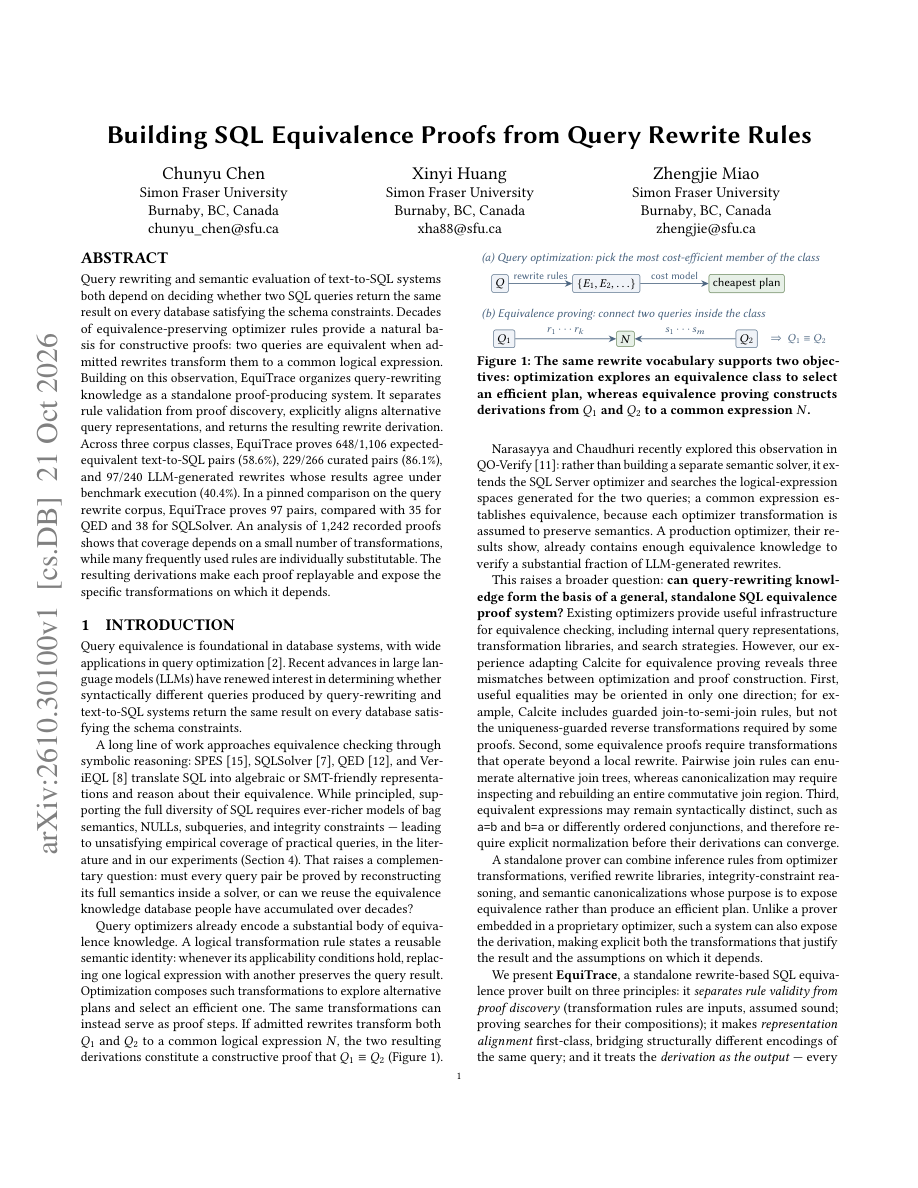
In the ever-evolving landscape of database management, the ability to establish whether two SQL queries yield the same results is paramount. Recent research led by Chunyu Chen and colleagues from Simon Fraser University introduces EquiTrace, a groundbreaking system that leverages existing query rewrite rules to construct direct equivalence proofs between SQL queries. This innovative approach not only enhances the reliability of text-to-SQL systems but also opens up new avenues for query optimization in database management.
The Challenge of SQL Equivalence
Understanding whether two SQL queries are equivalent is essential for various tasks, particularly in query optimization where efficiency is key. Traditionally, this equivalence has been checked using complex symbolic reasoning, leading to challenges in covering the vast diversity of SQL queries. Existing approaches often fall short, requiring intricate semantic models and resulting in limited success rates in practical applications.
EquiTrace addresses these shortcomings by harnessing decades of accumulated equivalence knowledge found in query optimizers. Instead of relying solely on heavy semantic solvers, EquiTrace utilizes rewrite rules—confirmable transformations that conservatively preserve the semantics of SQL queries—to establish equivalence in a more efficient and systematic manner.
Key Features of EquiTrace
EquiTrace operates on three foundational principles:
- Separation of Concerns: The system clearly distinguishes the validation of rewrite rules from the process of discovering proofs. This modular approach allows for the reuse of established transformation rules without needing to redefine them for each proof.
- Explicit Representation Alignment: EquiTrace facilitates the alignment of different query representations, making it easier to compare and transform distinct syntaxes into a common logical structure.
- Replayable Proofs: Each proof generated by EquiTrace includes a comprehensive record of every transformation applied, allowing for easy review and validation of the process, enhancing trust in its findings.
Impressive Results from EquiTrace
The results from testing EquiTrace are compelling. It successfully proved equivalence for 648 out of 1,106 expected pairs extracted from text-to-SQL systems, reflecting a 58.6% proof rate. Its performance was even more striking with curated query pairs, achieving 86.1% success. Furthermore, EquiTrace surpassed existing systems like QED and SQLSolver, proving a notable number of pairs that were beyond their reach.
EquiTrace’s unique ability to expose the derivation of each proof sheds light on the very transformations that sustain equivalence, thereby enhancing the understanding of the proof process itself. This replayability extends to the broader community, empowering developers and researchers with insights into SQL query structures and optimization strategies.
Beyond The Current Limitations
Despite these advancements, EquiTrace does encounter limits, particularly when faced with complex query structures or extensive join regions. The research indicates that achieving a common witness can be challenging when queries involve numerous tables or intricate relationships. Continuous improvements on transformation libraries and an emphasis on representational alignment may help bridge these gaps moving forward.
In conclusion, EquiTrace represents a significant leap forward in the realm of SQL query equivalence verification. By transforming the way we validate SQL queries, it not only enhances database optimization efforts but also enriches the field of database management as a whole. The implications for text-to-SQL systems are profound, potentially leading to more robust and efficient database operations.
Authors: Chunyu Chen, Xinyi Huang, Zhengjie Miao


