
From Contraction to Compression: How Strain Waves Cause Bending in Active Polymers
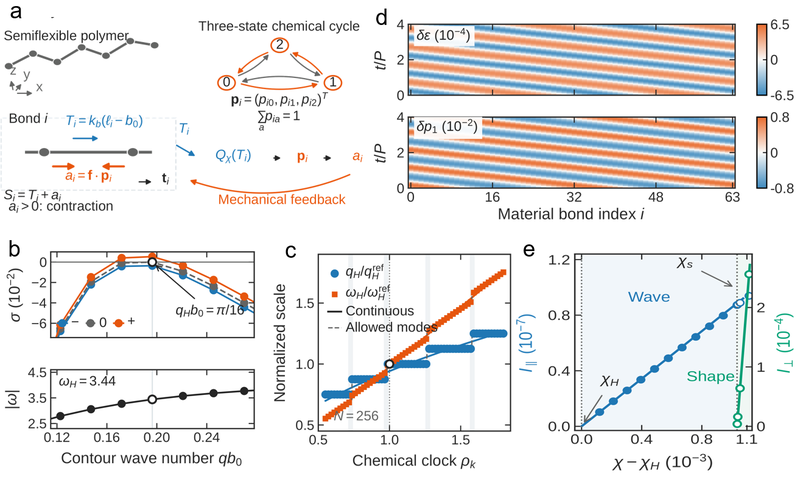
Recent research from the School of Physical Science and Technology at Soochow University unveils a fascinating mechanism in active polymers—materials that can generate movement without external forces. The study, conducted by Wen-de Tian and his team, reveals how traveling strain waves can lead to compression within these polymers, ultimately resulting in bending, a phenomenon that has profound implications in fields ranging from biology to materials science.
The Mechanics of Active Polymers
Active polymers are unique because they can exhibit movement driven by chemical reactions rather than relying solely on mechanical forces. Tian's study demonstrates that when these polymers are subjected to specific conditions, particularly by altering chemical transitions and bond elasticity, they can generate finite-wavelength traveling strain waves. These waves simultaneously reduce the mean active contraction—which is the polymer's tendency to shorten—while maintaining the overall elastic tension within the material.
Understanding the Compression-Bending Connection
The intriguing aspect of this research lies in its findings regarding how these strain waves can create a mean compression. When the polymer’s mean load is released, longitudinal waves continue to exist while transverse perturbations, or bending motions, tend to dissipate. Specifically, above a certain threshold, the compression caused by these traveling waves can trigger a bending instability, showcasing a complex interplay between chemical activity and mechanical responses.
Implications for Biological Systems
This research not only broadens our understanding of synthetic materials but also offers insights into biological systems. For instance, the behavior of chromatin—material found in the nucleus of living cells—exhibits similar coordinated movements driven by motors and chemical forces. The findings could help elucidate how chromatin behaves under various conditions, impacting gene expression and cellular functions.
Conclusion: A New Perspective on Material Behavior
The work of Tian and his colleagues highlights the critical role of chemical dynamics in polymer mechanics. By demonstrating that strain waves can catalyze compression which leads to bending, the study opens new avenues for research and applications in soft materials, robotics, and even biomedical engineering, where controlling polymer properties is essential. As researchers delve deeper into these interactions, we may witness a transformation in how we design and utilize active materials in the future.
Authors: Wen-de Tian, Kang Chen, Tianhui Zhang


