
Fluid Mastery Unleashed: How SplashSplat Captures the Art of Liquid Dynamics in Real-Time
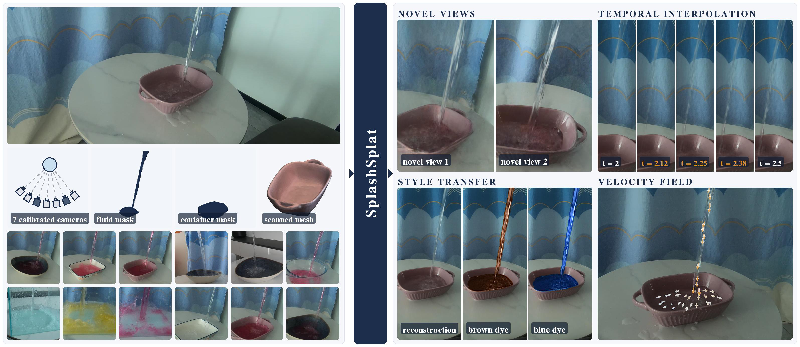
In the fascinating world of fluid dynamics and visual effects, capturing the beauty of splashing liquids has been a significant challenge for researchers and engineers alike. A groundbreaking research paper titled "SplashSplat: Reconstructing Splashing Liquids from Real-World Multi-View Videos," authored by Peiyu Liu, Dingxi Zhang, Federico Tombari, Marc Pollefeys, Christina Tsalicoglou, and Daniel Barath, introduces innovative methodologies and a unique benchmark that promise to revolutionize how we perceive and reconstruct liquid splashes.
The Quest for Realistic Fluid Capture
Previously, attempts to digitally replicate splashing liquids faced many hurdles, including the complex and fleeting nature of splashes, which dissolve into calm moments almost instantaneously. Traditional methods primarily focused on smoke or gentle flows, neglecting the intricate beauty of splashes. SplashSplat addresses this gap with a pioneering approach by creating the first-ever synchronized multi-view video benchmark comprising real scenes of splashing liquids.
The research features 20 diverse scenes utilizing a synchronized setup of seven calibrated 4K cameras, capturing the rapid transformation from liquid streams to chaotic splashes at an impressive rate of 60 frames per second. This dataset allows for comprehensive analysis and comparison of different reconstruction techniques while providing crucial insights into fluid mechanics.
How SplashSplat Works
At the heart of this research lies the SplashSplat methodology, which adopts a simple yet elegant principle: apply physical structure only where data supports it. Unlike previous methods reliant on comprehensive motion simulators, SplashSplat utilizes a hybrid strategy:
- Geometry Fusion: The method integrates liquid signed distance fields from multiple camera perspectives to define the fluid's geometry accurately.
- Coarse Velocity Estimation: By evaluating consecutive signed distance fields, a coarse velocity field is estimated to ensure the motion adheres to physical realities.
- Material Advection: Using Lagrangian carriers, the study tracks and deforms fluid particles along this flow, preventing them from drifting into the background or losing spatial coherence.
This approach has been shown to produce results that are not only physically plausible but also cost-effective in terms of training time and resources compared to existing techniques.
Benchmarking Real-World Liquid Dynamics
The introduction of the SplashSplat benchmark presents an invaluable resource for researchers working in computer graphics and fluid dynamics. The dataset allows methodical evaluation of various rendering techniques, and its innovative design supports applications ranging from visual effects in film to simulations in educational environments. The ability to recreate splashing behaviors accurately translates into enhanced training for AI models and more realistic virtual environments.
Further experimentation has showcased SplashSplat's capabilities in novel view synthesis, temporal consistency, and style transfer, outpacing conventional dynamic Gaussian splatting methods in both quality and efficiency. The implications of this research extend beyond mere aesthetics; they pave the way for future breakthroughs in AI-driven simulations and visual representations of fluid dynamics.
Conclusion: A New Era in Fluid Reconstruction
SplashSplat stands as a testament to the remarkable confluence of technology and creativity. By enabling researchers to accurately reconstruct the ephemeral beauty of splashing liquids, this method not only enriches the field of computer graphics but also provides a foundational tool for various applications across industries. As we continue to explore the depths of fluid dynamics through innovative research, SplashSplat illuminates the path forward for more dynamic and visually captivating virtual worlds.
For further details and access to the project, visit SplashSplat Project Page.
Authors: Peiyu Liu, Dingxi Zhang, Federico Tombari, Marc Pollefeys, Christina Tsalicoglou, Daniel Barath




