
Flipping the Script on AI Failures: A Groundbreaking Strategy for Real-Time Detection and Repair of LLM Agent Failures
In the world of AI, failure is often a silent adversary. Researchers led by Sunny Dubey have unveiled an innovative approach to tackle this very issue—detecting and repairing failures in large language model (LLM) agents before they escalate. Their recent study provides an in-depth analysis of how observable telemetry can serve as a lifeline for identifying issues in real-time, offering a sophisticated yet lightweight solution to keep AI on course.
Understanding Agent Failures
LLM agents often stumble in their tasks, resulting in errors that can include looping, drifting off goals, or even fabricating results. Traditional methods of detecting these failures usually rely on a second LLM to evaluate each step, which can be costly and impractical. Dubey and his team sought to explore if significant failure detection could be achieved using just the telemetry data generated during the agent's operation—essentially looking at how the agent behaves and changes over time without adding additional system load.
Developing the Detection Framework
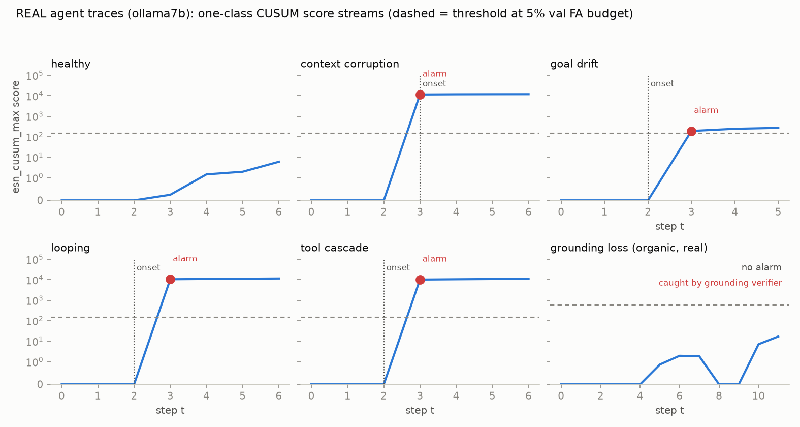
The researchers introduced a series of increasingly sophisticated monitoring models that analyze output telemetry data, capturing essential indicators of potential failures as they arise. The primary model utilized an echo-state network (ESN) and incorporated a CUSUM (cumulative sum control chart) alarm system that adjusts to variations over a sequence of agent steps.
This approach laid the groundwork for three distinct monitoring models. The first effectively identified failures that had time to develop, while a later hybrid model improved its sensitivity by adapting based on the deployment context. The game's final contender was a content-grounding telemetry channel that significantly boosted the ability to detect content corruption, a previously overlooked failure mode.
Real-World Applications and Impressive Results
The research was validated through comprehensive testing across 2,823 agent episodes, demonstrating an impressive capacity to detect and rectify issues. The monitoring systems were effectively able to recover nearly half of the failures flagged, which led to a marked increase in overall task success rates—from 52% to an encouraging 73%. This method offered quick analysis, requiring less than a millisecond per step, compared to the lengthy recalibrations typically necessary with conventional monitoring methods.
Blueprint for Future AI Reliability
Dubey's work not only illustrates a robust detection method but also emphasizes a crucial concept in AI: the importance of recovery systems. By integrating real-time monitoring and automated recovery processes, applications ranging from personal assistants to critical decision-making systems can benefit from enhanced reliability, potentially reducing the often uncertain outcomes associated with AI operations.
This research, pushing the boundaries of what AI can achieve, enables a future where technology not only performs tasks but does so with remarkable resilience to errors and failures, thus instilling a greater trust in its capabilities.
In a rapidly advancing digital landscape, the implications of Dubey’s findings are profound, reminding us that even the most sophisticated AI systems require diligent oversight and innovative solutions to ensure they serve humanity effectively.
Authors: Sunny Dubey




