
Exposing a Hidden Danger: How Weather Data Manipulation Poses Risks in V2X Communication
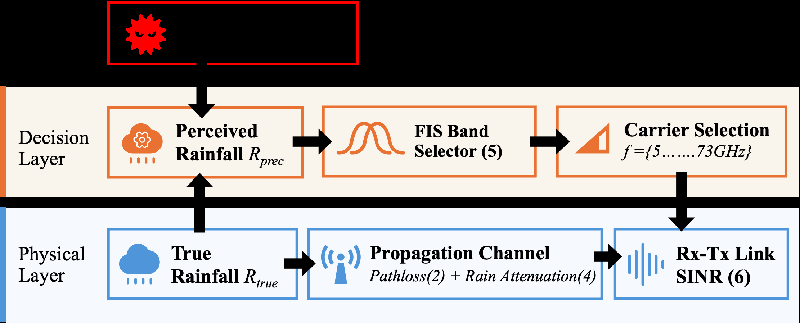
In the evolving world of connected vehicles, safety hinges on seamless communication between vehicles (V2X) and their environmental sensors. A recent study by researchers from South Carolina State University and North Carolina A&T State University unveils a significant vulnerability: weather data spoofing. This research explores how adversaries can manipulate vehicle communication by altering weather inputs to affect frequency selection, impacting the reliability and safety of vehicular networks.
The Crux of the Research
Connected and automated vehicles rely on millimeter-wave (mmWave) communication for high data rates necessary for cooperative driving. The study identifies a potential attack surface where the vehicles' reliance on weather inputs for selecting communication frequencies can be exploited. By spoofing rainfall data, attackers can control a vehicle's communication band—significantly impacting its operational range and reliability.
A New Type of Attack
The study categorizes the spoofing into two types:
- Type 1 (Force-Up): An attacker reports clear skies, causing the vehicle to select a high-frequency band that performs poorly in rain, severely restricting communication range.
- Type 2 (Force-Down): An attacker claims heavy rainfall, forcing the vehicle to fall back to a low-frequency band, which enhances range but significantly reduces data capacity and increases latency.
This dual approach exposes a vulnerability that could have serious implications in real-time vehicular communication, especially in safety-critical scenarios where connectivity is paramount.
Research Insights and Implications
Utilizing a simulation platform called MilliCar, researchers demonstrated that forcing a vehicle to operate at unfavorable frequency bands dramatically affects its communication capabilities. The study revealed that:
- When subjected to an attack, a vehicle's reliable communication range could collapse to just 38 meters, compared to an optimal baseline range of 82 meters without interference.
- For maximum data effectiveness, adaptive frequency selection is crucial; however, without authentication of the weather input, it becomes susceptible to malicious manipulation.
These findings highlight the need for secure, authenticated channels of weather input to protect against such spoofing attacks in vehicle-to-everything communications.
Proposed Mitigation Strategies
The researchers propose several defense mechanisms, one being the implementation of a receiver-side detector that monitors the signal-to-interference-plus-noise ratio (SINR) against the anticipated attenuation based on reported weather conditions. This detection method could flag potentially manipulated data points quickly, although, as noted, it may not be able to identify all types of spoofing.
Effective authentication of meteorological inputs emerges as a critical strategy to ensure reliable vehicle communication and protect against future threats. The study serves as a wake-up call for automotive manufacturers and cybersecurity professionals alike to strengthen defenses within connected vehicle networks.
Conclusion
This research underscores the intricate relationship between vehicle communication systems and environmental data. As vehicles become increasingly interconnected, securing data inputs against manipulation is essential for ensuring safety and reliability in modern transportation. The insights from this study not only pave the way for further research into protective measures but also highlight the necessity for comprehensive cybersecurity frameworks in the autonomous vehicle arena.
Authors: Rasheed Bello, Idreez Yusuf, Justice Adjei Owusu, Oluwatobiloba Aiyewunmi, Gurcan Comert, Judith Mwakalonge, Esmail Abuhdima, Abdulmajid Mrebit, Rajab Ataai, Vaidyan Varghese




