
Exploring Unified Video World Models: The Next Frontier in AI Interaction
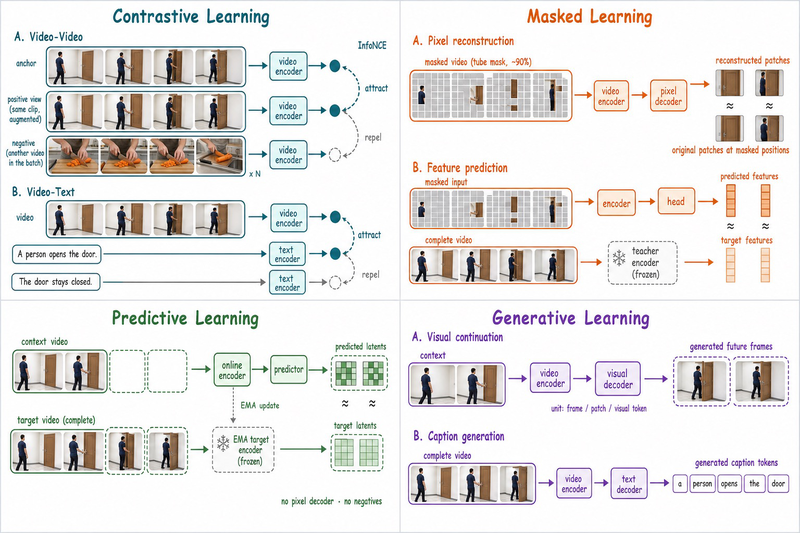
In a groundbreaking survey titled "Reading, Writing, Sharing, and Interacting with the World through Video," researchers Shengqiong Wu, Meng Luo, Bobo Li, and their colleagues delve into the emerging field of video foundation models and their potential to revolutionize how machines understand and generate video content.
The Intersection of Video Models and World Dynamics
At the core of this research is the concept of "video world models," which serve to connect the observable aspects of a video with the latent dynamics of its underlying context. This idea is pivotal, as it allows for an advanced understanding of how videos can be interpreted not just as static sequences, but as representations of an evolving world.
The authors categorize the complexities of video interaction into four operations: reading, which infers properties from observed video; writing, which involves synthesizing video from given conditions; sharing, facilitating comprehension and generation within a unified framework; and interacting, predicting how the world state evolves based on actions and observations.
Transitioning from Passive to Interactive Understanding
One of the significant outcomes of this research is the evolution from passive video prediction to interactive world modeling. Traditionally, models could predict what happens next in a video based purely on historical frames. However, the authors stress the importance of incorporating interactions where new actions dynamically change the output of the state, creating a feedback loop that enhances predictive accuracy and realism.
For instance, a video model could alter its predictions based on user inputs, permitting a much more sophisticated interaction pattern that emulates real-world decision-making processes.
Open Challenges Ahead
The survey identifies critical challenges that need to be addressed to push this field forward. These include:
- Long-horizon consistency: Ensuring that predictions maintain accuracy over extended sequences without losing essential contextual information.
- Physical and causal grounding: Establishing that envisioned motions adhere to physical laws and that changes in environment can be accurately represented.
- Measurable synergy: Developing benchmarks that can effectively measure the interaction between understanding and generation in unified models.
Moreover, the authors emphasize that merely increasing data availability is insufficient; interventions that explicitly track how changes affect predictions are essential for model improvements.
Further Implications and Applications
The implications of these unified video models span numerous applications, from enhanced robotics and autonomous driving scenarios to content creation in digital media. Not only do they pave the way for better-trained models, but they also set a foundation for creating robust interactive systems that can adapt to and learn from dynamic environments.
In conclusion, Wu and colleagues' survey marks a crucial step in the pursuit of developing AI systems capable of more human-like interactions with the world through video understanding and generation. The challenges outlined present exciting avenues for future research that could redefine AI's role in media and perception-based tasks.
As technology continues to advance, these models hold the potential to shape our experiences with visual media, creating richer and more meaningful interactions.
Authors: {Shengqiong Wu, Meng Luo, Bobo Li, Ziwei Liu, Shuicheng Yan, Ming-Hsuan Yang, Philip Torr, Hao Fei}


