Discovering the Future of Artificial Life: Machine Zygote and the Quest for Causal Heredity Before Learning!
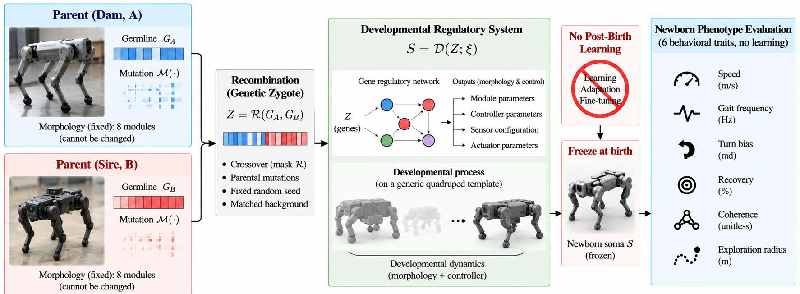
In an exciting leap within the realm of artificial intelligence, a groundbreaking research paper by Lyes Saad Saoud unveils the potential of the "Machine Zygote"—a unique framework aimed at exploring biparental heredity in artificial agents before the onset of learning. This innovative model raises essential questions about how artificial life can inherit traits from parent entities and whether these inherited characteristics can be isolated in a causal context.
The Core Concept of Machine Zygote
At the heart of this research lies a computational architecture designed to simulate a developmental phase without any learning occurring post-birth. The "Machine Zygote" effectively combines genetic information from two parental sources, termed as the dam and sire, to create a zygote—a combination of these genetic materials. In this model, key behavioral traits of the newborn are evaluated right after birth, allowing researchers to examine how parental influences affect these traits without the interference of learned behaviors.
The study demonstrates that five out of six evaluated traits show significant dependence on the parental contributions of the dam and sire, establishing a framework where the offspring's characteristics can be causally linked to their genetic origins.
Methodology in a Nutshell
The research employed a robust experimental setup involving a 4 x 4 diallel—this means there were various combinations of mothers and fathers used to produce a significant number of offspring (640 in total). By carefully controlling the backgrounds and ensuring that none of the offspring learned or adapted during observation, the study clearly underscored the significance of genetic contributions to the resultant traits of these artificial beings.
An equally intriguing aspect of this research is its clear definition of terms like "germline" and "soma." In simple terms, the germline is the genetic makeup that defines the offspring, while the soma represents the operational structure of the artificial agent that dictates its behavior, isolating the influence of parental traits.
Key Findings That Could Shape the Future of AI
The results of the study showcased intriguing insights: substantial shifts in phenotype (or observable characteristics) were observed simply by substituting one parental germline for another while controlling other variables. The traits analyzed—such as speed and gait frequency—illustrate that altering parental genetic material directly influenced the offspring's capabilities.
Moreover, the research found that a different approach could yield offspring with superior characteristic traits beyond the capabilities of their parent lines—a phenomenon known as "transgressive offspring." This novel insight indicates that recombination at the genetic level can produce unexpected enhancements in artificial entities.
Why This Research Matters
While Machine Zygote does not yet bridge the gap to physical heredity or self-replicating systems, it lays the foundation for future inquiries into how artificial agents can be designed better, possibly accelerating developments in evolutionary robotics and artificial life. This exploration helps define how certain traits can be intentionally shaped through targeted genetic influences, promoting an understanding of how artificial intelligence can evolve over time.
In sum, the work presented in this paper presents a crucial methodological step forward in studying artificial ontogeny, and its effects go beyond theoretical implications, providing a tangible framework for harnessing heredity in the evolution of intelligent machines.
Authors: Lyes Saad Saoud, Independent Researcher, Chicago, Illinois, USA; Abu Dhabi, UAE