
Decoding the Financial Mind: How Trends Shape Market Risks in Unexpected Ways
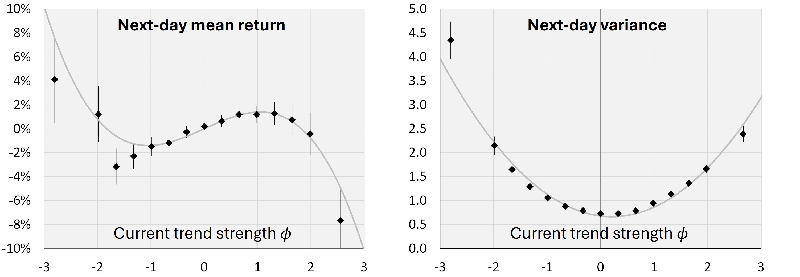
Financial markets are influenced by a myriad of factors, yet the dynamics of trends often remain underexplored. A recent study by Sara A. Safari and Christof Schmidhuber sheds light on this crucial aspect, revealing that current market trends can significantly predict future volatilities and correlations among assets. Using a robust dataset encompassing 33 years of financial data across multiple markets, the researchers provide novel insights into the predictive power of trend strengths.
Understanding Trends in Financial Markets
In the realm of finance, trends refer to the general direction in which an asset's price is moving. This paper builds upon previous works that utilized cubic mathematical functions to predict future returns based on the strength of current trends. What sets this research apart is its focus on how not just returns, but also variance (the measure of price fluctuations) and correlations (the degree to which different assets move together) can be forecasted by these trends.
A New Approach to Predicting Market Volatility
The research reveals that periods of strong trends, especially downward ones, are associated with increased market volatility. This phenomenon can be quantitatively modeled using quadratic polynomials, enhancing traditional mean-reversion models. Simply put, when a market is experiencing a significant uptrend or downtrend, the unpredictability of asset prices tends to rise dramatically.
One particularly compelling finding is that negative trends (declines in asset prices) can amplify the variance of future returns more significantly than positive trends. This is a critical insight for investors, as it suggests that downturns may signal heightened market risk.
Correlations Through the Lens of Trends
The researchers also explored how global trends affect the correlation between different asset classes. They found that correlations tend to increase during periods of market distress — notably when multiple assets are in strong downtrends. This means that during financial crises, investors should expect that assets will likely move together, resulting in greater overall risk exposure.
Implications for Market Risk Management
By understanding the functional relationship between current trend strengths and future market behaviors, investors can better manage risk. The findings of this study could enhance existing risk management strategies, enabling more informed decision-making during volatile market conditions.
The research aligns with recent proposals to view financial markets as systems approaching critical points, where small changes can result in extreme behaviors. This perspective not only enriches the theoretical framework of financial modeling but also offers practical tools for market practitioners.
Concluding Thoughts
The work of Safari and Schmidhuber represents a significant leap forward in comprehending the dynamics of financial markets. By showcasing the interconnections between trends, volatilities, and correlations, their research urges investors to be more vigilant in recognizing market signals that could indicate future risks. As financial landscapes continually evolve, understanding these patterns will be key to achieving enduring success in investment strategies.
As we draw on empirical evidence to refine our approaches to financial forecasting, the implications of this study encourage a reevaluation of how trends play into the broader narrative of market behavior.
Authors: {Sara A. Safari, Christof Schmidhuber}




