
Decoding Cybersecurity: The Groundbreaking Insights of VX-One in Perimeter Triage
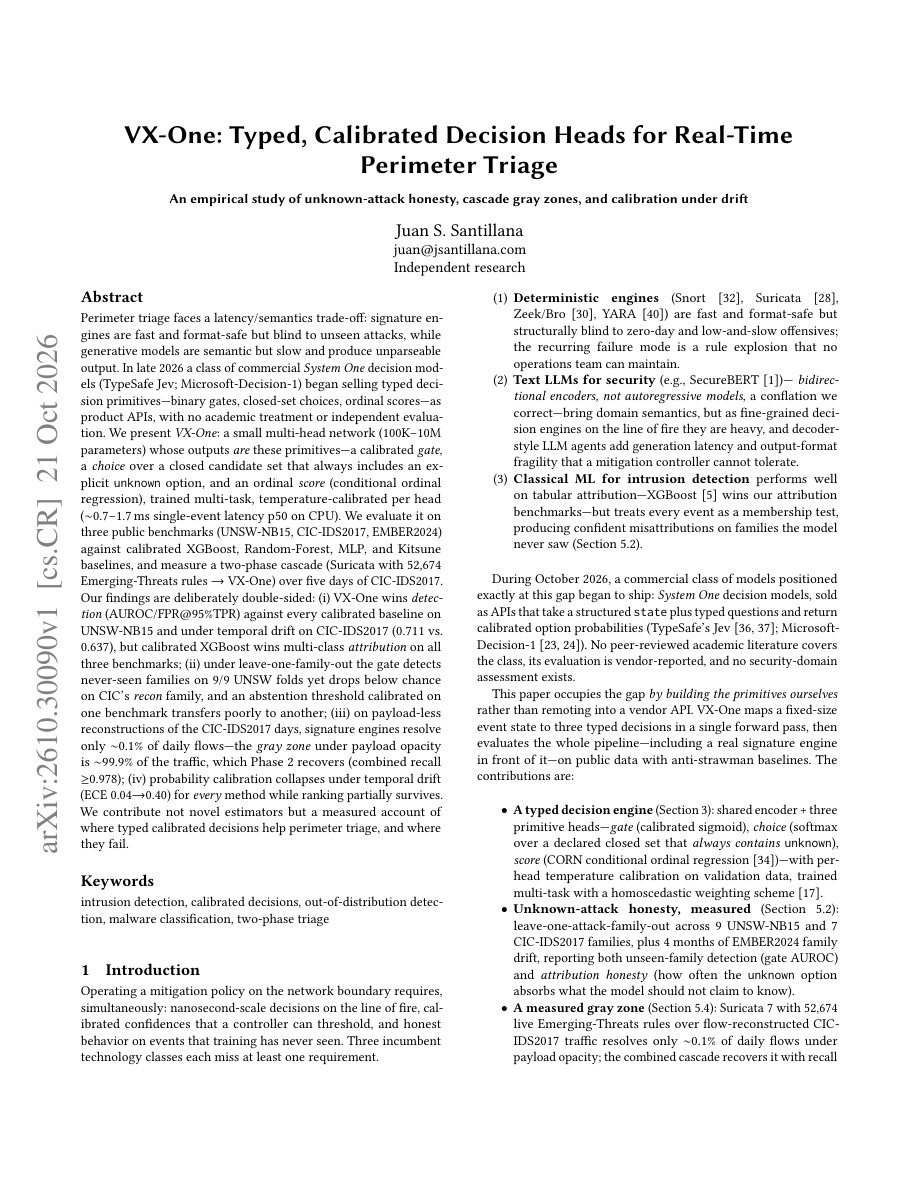
A new study by Juan S. Santillana introduces VX-One, a novel decision-making model aimed at revolutionizing how cybersecurity systems handle threats at their perimeters. With the increasing sophistication of cyber-attacks, timely and reliable threat detection is paramount. VX-One addresses both the speed and accuracy of threat assessments, utilizing what the author describes as 'typed calibrated decision heads.'
What is VX-One?
VX-One is a multi-head neural network designed to perform real-time perimeter triage, making quick and informed decisions about network threats. Traditional intrusion detection systems often face a dilemma: they can either be fast and robust with format-safe responses (as seen in signature engines) or more comprehensive but slower due to reliance on complex generative models. VX-One attempts to bridge this gap by using smaller networks with precise decision-making capabilities.
Key Innovations
The research outlines several key features that set VX-One apart from existing systems. Firstly, it employs a system of typed decisions: a calibrated gate that indicates the presence or absence of a threat, a choice head that engages various known outcomes while providing an option for unknown situations, and an ordinal score that ranks the severity of identified threats. The architecture is fine-tuned to ensure swift processing—reporting a latency as low as 0.7 to 1.7 milliseconds for single-event processing on a CPU.
Testing and Performance
To validate its effectiveness, VX-One was evaluated against multiple established benchmarks, including UNSW-NB15 and CIC-IDS2017. In these tests, VX-One demonstrated superior detection capabilities in environments with evolving threats—finding success in detecting previously unseen attack families.
However, the results were not entirely one-sided. While VX-One excelled in terms of threat detection, another model, calibrated XGBoost, outperformed it in multi-class attribution across various datasets. This points to an essential takeaway: while VX-One shines in detection, it also highlights the nuanced balance cybersecurity professionals must strike between detection and attribution accuracy.
Challenges Identified
Despite its advancements, VX-One surfaces some challenges. The study notes that probability calibration collapses under temporal drift—indicating that its context-sensitive accuracy can diminish when faced with previously unseen family attacks. Additionally, achieving a portable abstention threshold, which allows the system to refrain from making potentially harmful assumptions about unknown threats, proved challenging across different datasets.
The Future of VX-One
What’s next for VX-One? The potential for refinement and adaptation stands high, aiming to mitigate its limitations and improve decision thresholds based on dynamic network behavior. As cybersecurity continues to evolve, so too must the tools designed to protect our digital landscapes. VX-One represents a pivotal step in this ongoing journey toward more robust, accurate, and responsive cybersecurity measures.
Conclusion
In conclusion, VX-One presents an intriguing approach to decision-making in real-time perimeter triage, demonstrating noteworthy capabilities in identifying and categorizing threats effectively. As cyber threats grow in sophistication, further explorations and refinements of models like VX-One will be critical in enhancing our defenses, ensuring that we stay a step ahead in the digital battleground.
Authors: {Juan S. Santillana}


