
Decoding Collective versus Scrambling Dynamics: A Breakthrough in Long-Range Quantum Spin Models
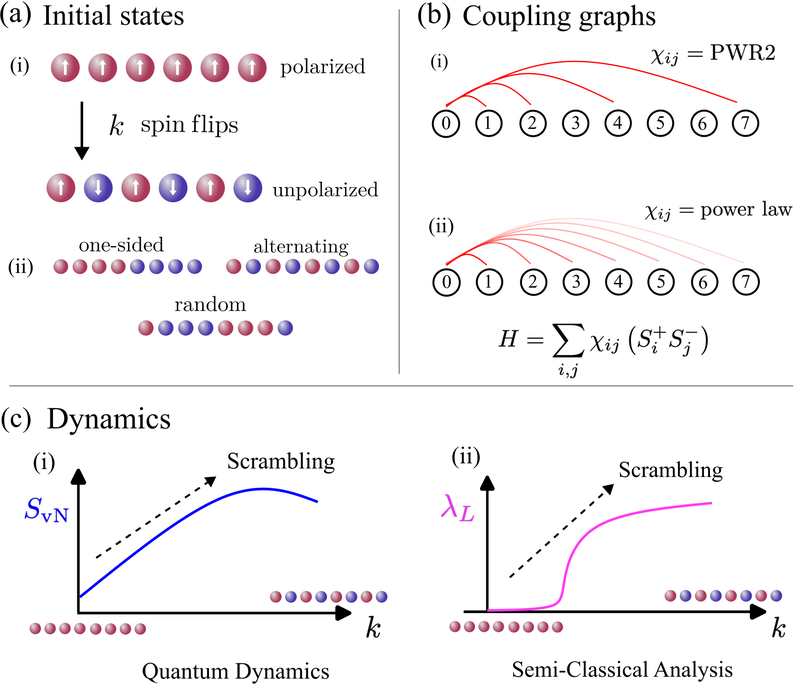
In a landmark research paper, physicists from the University of Oxford and the University of Strathclyde have unveiled a novel investigation into the dynamics of long-range quantum systems. Titled fTuning between collective dynamics and scrambling through initial-state symmetry alignment in long-range spin models, the study sheds light on how varying the initial state in these systems can trigger radically different dynamical behaviors, evolving from orderly collective states to complex scrambling phenomena.
The Heart of Quantum Many-Body Dynamics
Quantum many-body dynamics is effortlessly fascinating; it shapes how quantum information spreads and interacts within a system. The researchers explored Hamiltonians characterized by long-range couplings, examining two central models: the powers-of-two (PWR2) graph and a power-law decaying model. These models describe interactions where each spin can influence others over varying distances, showcasing behaviors ranging from integrated mean-field dynamics to rapid scrambling of quantum information.
From Order to Chaos: A Pivotal Discovery
One of the key breakthroughs in this research is the demonstration that the dynamics of these spin models can transition from an orderly, collective state to a chaotic, scrambling state merely by altering the initial conditions. By adjusting the number of 'flipped' spins from an initial completely symmetric state, the team could observe a distinct crossover—shifting the quantum system's behavior dramatically based on how the initial state deviated from uniformity.
A Novel Framework for Understanding Quantum Transitions
This study not only characterizes the crossover using entanglement measures but also introduces Lyapunov exponents as a crucial tool for classifying the dynamical regimes in question. The results indicate that the interplay of long-range interactions and local modifications in the initial state can be effectively analyzed through the spectral properties of the Coupling graph. This approach is a significant leap forward in understanding how chaotic dynamics emerge in quantum systems.
Implications for Quantum Experimentation
What makes this research particularly exciting is its accessibility for experimental validation. The scenarios presented have applications in current quantum simulation platforms, such as neutral atom arrays and quantum dots, where physicists can test these findings in real-time. These insights not only deepen our comprehension of quantum dynamics but also pave the way for engineers and experimentalists to harness quantum systems' complex behaviors for practical advancements, such as in quantum computing and information processing technologies.
Conclusion: A New Dawn in Quantum Understanding
The insights gleaned from this research can potentially reshape our understanding of quantum many-body systems, showcasing the inherent unpredictability and richness of quantum dynamics that lie in manipulation of initial states. As the research field continues to evolve, the power of comprehending dynamics—from collective to scrambling—opens new frontiers for quantum technology and fundamental physics alike.
Authors: Sridevi Kuriyattil, Johannes Kombe, Andrew J. Daley, Pablo M. Poggi


