
Cracking the Code of Robot Performance: How Sensorimotor Alignment Can Predict Success
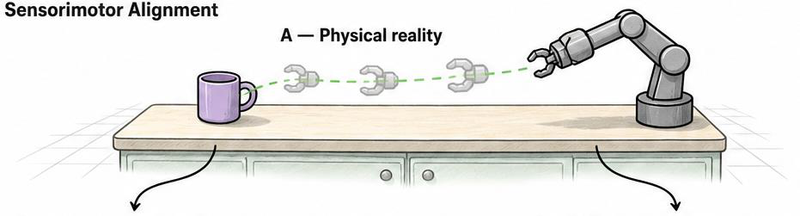
In a groundbreaking study led by researchers from Rice University and NVIDIA, a new metric known as Sensorimotor Alignment (S2) has been proposed to evaluate the capabilities of robotic models. This innovative measure aims to replace costly closed-loop evaluations, making it easier and cheaper to determine the operational success of robots in real-world scenarios.
What is Sensorimotor Alignment (S2)?
At its core, Sensorimotor Alignment serves as an offline proxy for evaluating robotic models. By examining the alignment between a robot's sensory representations—essentially how they perceive the world through visual and textual information—and their motor representations, or the physical trajectories the robot executes, researchers can gain insights into the robot's general capability.
The study is built upon the Platonic Representation Hypothesis (PRH), which posits that as models learn and develop, their various sensory modalities—like vision and language—align closely around a shared understanding of reality. This hypothesis extends to the realm of robotics, suggesting that as robotic models become more sophisticated, their sensory inputs should align more closely with their motion outputs.
Key Findings of the Research
The researchers found that a higher S2 score correlates positively with the robotic models' success in completing various tasks. More specifically, the experiments revealed that:
- The S2 metric showed a significant correlation with task success rates across multiple model families.
- For vision-language-action models (VLAs), a strong correlation of r = +0.717 was obtained, indicating that models with higher sensorimotor alignment are more likely to perform better in tasks.
- S2 proved to be a better predictor of success than traditional metrics, such as visual question answering scores and video quality metrics.
Implications for Future Robotics Research
As robotics continues to evolve, the need for cost-effective and efficient evaluation methods becomes increasingly critical. Sensorimotor Alignment not only provides a way to prioritize which models should undergo expensive closed-loop evaluations but also serves as a diagnostic tool to understand model behaviors at a deeper level. Given its strong empirical foundation, S2 encourages future robotics researchers to focus on optimizing robotic models for enhanced sensorimotor alignment, potentially leading to more capable and efficient robots.
The Path Forward
While the study indicates significant promise for Sensorimotor Alignment, there are limitations. The relationship found between S2 and task success is correlational; future work is needed to determine whether sensorimotor alignment can be directly optimized to improve performance across robotic applications.
As we look to the future of robotics and artificial intelligence, the insights from this research underscore the need for innovative metrics that can drive development and ensure greater success in real-world applications.
For more information about the study, you can visit the authors' project page here or access the code on their GitHub repository.
Authors: {Yunfei Xie, Howard H. Qian, Shiyi Lan, Kaiyu Hang, Chen Wei}


