
Cracking the Code of Interpretability: How Graphs Transform Natural Language Inference!
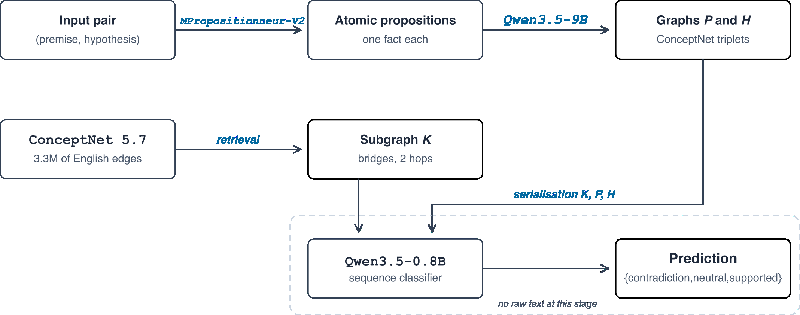
In the rapidly evolving realm of artificial intelligence, understanding how machines process and interpret information is crucial, especially in Natural Language Inference (NLI). A groundbreaking research paper from authors Younes Boufouss, Luc Pommeret, Thomas Gerald, Patrick Paroubek, and Sophie Rosset takes a bold step towards this goal. They explore whether NLI can be achieved entirely through interpretable, graph-based representations, setting the stage for a new era in AI reasoning.
What is Natural Language Inference?
Natural Language Inference is a key task in Natural Language Understanding, requiring systems to determine the relationship between statements. Essentially, it involves reasoning to conclude whether a premise supports, contradicts, or is neutral towards a hypothesis. Traditional NLI systems, particularly those utilizing Large Language Models (LLMs), have achieved impressive accuracy, but they often lack transparency in how decisions are made—a significant barrier for trust and usability.
Introducing the Graph-Based Approach
The researchers present a novel pipeline that utilizes graphs instead of raw text for classification. In their approach, sentences are broken down into atomic propositions—simple statements that can be further processed. These propositions are converted into ConceptNet triples, creating structured graphs representing the premise, hypothesis, and an additional knowledge graph retrieved from ConceptNet. This method aims to make the reasoning process more interpretable and transparent.
The Price of Interpretability
As the study reveals, there’s a trade-off involved in utilizing graphs for NLI. On the SNLI benchmark, the proposed graph-based model achieves an impressive accuracy of 89.7%, only slightly trailing behind text-based models by just 1.9 percentage points. However, on more challenging datasets, such as ANLI, the performance gap widens, revealing a difference of 9 to 14 points. This gap highlights the "price of interpretability," suggesting that while graph-based models offer increased transparency, they may require enhancements to match the accuracy of their text-processing counterparts.
Complementing Text with Graphs
Interestingly, the research also demonstrates that combining both graph-based and text-based approaches can yield superior results. Integrating the strengths of both modalities led to an impressive accuracy of 92.1% on SNLI. This suggests that rather than seeing graphs as a replacement for text, they should be viewed as complementary tools that can enhance reasoning capabilities.
Conclusion and Future Implications
Boufouss and his colleagues have opened a new avenue for AI research by showcasing the potential of using interpretable graphs in NLI tasks. Their findings may not only contribute to the advancement of AI reasoning but also pave the way for more accountable and understandable AI systems. As AI continues to become intertwined with everyday life, establishing a clear path toward interpretability and transparency has never been more important.
These insights encourage further exploration into enhancing the representational power of graph-based systems, thereby bridging the gap between interpretability and accuracy while fostering greater trust in AI technologies.
Authors: Younes Boufouss, Luc Pommeret, Thomas Gerald, Patrick Paroubek, Sophie Rosset




