
Cloud Caching Costs Exposed: The Game-Changer for Managing Egress Fees
A groundbreaking study reveals the hidden costs of cloud caching and provides a revolutionary framework for understanding when it's crucial to be dollar-aware. As businesses increasingly rely on cloud object storage services—where fees are based on requests made and data transferred—this research offers crucial insights into efficient cash management that could save companies substantial amounts.
The Problem with Traditional Caching Methods
Traditionally, caching strategies, like the Least Recently Used (LRU) method, focus on minimizing the number of cache misses, but this approach can lead to expensive pitfalls. With the billing structure of cloud services charging per GET request and data egress, a rarely accessed but costly object can bleed businesses dry, costing thousands of dollars compared to frequently accessed cheap objects. The study presents a serious critique of this outdated objective and sets the stage for a new paradigm.
Setting the New Benchmark: Exact Dollar-Optimal Reference
The authors of the study, Madhulatha Mandarapu, Sandeep Kunkunuru, and others, unveil a method to accurately determine the dollar-optimal caching solution using integral interval linear programming. This approach allows businesses to predict how much a cache strategy will cost them, fundamentally altering how caching decisions should be made. By comparing real-life scenarios against this dollar-optimal reference, organizations can see just how far their existing heuristics are from what they could achieve.
Understanding the Heterogeneity-Regret Law
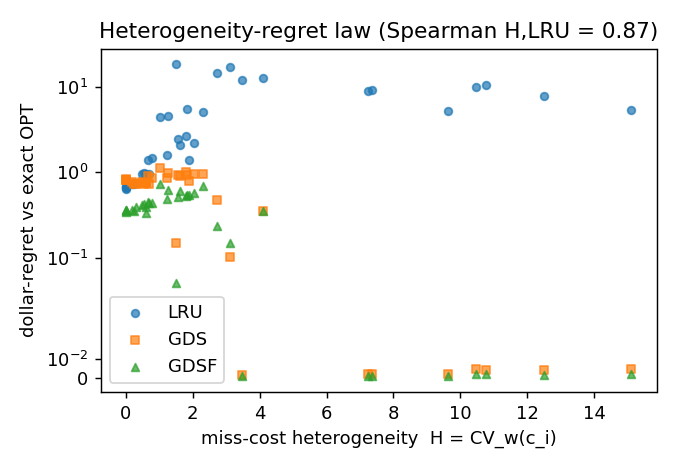
One of the most intriguing findings of the research is the "heterogeneity-regret law." It highlights that traditional caching methods tend to perform worse as the costs associated with missed cache hits become more diverse. For instance, while LRU shows a gradual increase in dollar-regret as costs become more heterogeneous, the GreedyDual approach significantly mitigates these costs. This insight encourages businesses to adopt a more nuanced cost-aware caching strategy.
The Crossover Point: A New Benchmark for Businesses
Perhaps the most compelling breakthrough is the introduction of the crossover point, denoted as s⋆, which predicts when businesses should switch to cost-aware caching. This simple formula compares the GET fee to the egress rate and gives a critical threshold—below which traditional caching strategies may suffice, but above which sophisticated, dollar-aware approaches are essential. This transition point varies between different cloud providers, emphasizing the need for businesses to tailor their caching strategies accordingly.
A Real-World Application and Its Implications
The researchers employed real Twitter cache data to validate their findings, revealing that the prevailing prices can shift the requirement for a dollar-aware caching strategy. This real-world example illustrates the urgent need for companies to regularly evaluate their caching policies in relation to changing cloud pricing structures. By adopting these insights, businesses can potentially avoid large unnecessary expenditures.
As cloud computing continues to evolve, understanding the intricacies of billing and optimizing cache strategies using this research can mean the difference between profit and loss. The findings empower businesses to rethink their approach to caching, prioritizing cost-efficiency in a landscape where every byte counts.
Authors: {Madhulatha Mandarapu, Sandeep Kunkunuru}




