
Chunking Revolution: How Update Costs Can Make or Break Document Retrieval Systems
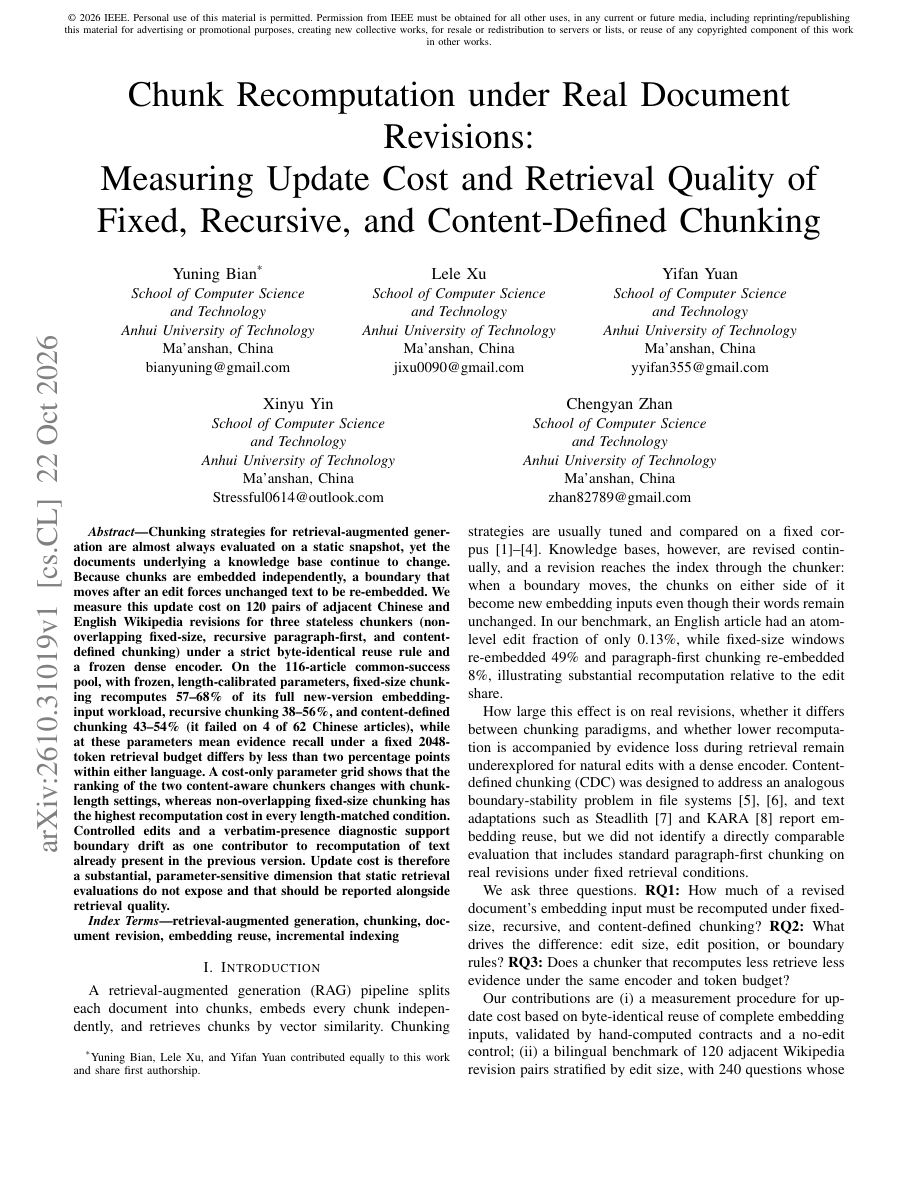
A recent research paper sheds new light on the hidden costs associated with different chunking strategies in retrieval-augmented generation (RAG) systems. Authored by Yuning Bian, Lele Xu, Yifan Yuan, Xinyu Yin, and Chengyan Zhan from Anhui University of Technology, this study challenges established practices in evaluating chunking methods, especially as knowledge bases frequently undergo revisions. The findings suggest that the update costs incurred by chunking strategies can significantly impact performance, even when retrieval accuracy appears stable.
The Bigger Picture: Understanding Chunking in RAG Systems
Chunking is a process used in natural language processing where documents are broken down into smaller pieces or "chunks." This allows for efficient querying and retrieval of information. Traditionally, evaluations have been conducted on static versions of these documents, but as documents are revised, the embedded chunks need to be re-evaluated. The authors aimed to quantify how much of a revised document must be re-embedded under different chunking strategies and what factors influence this recomputation cost.
Key Findings: Update Costs Exposed
The study examined three types of chunking approaches: non-overlapping fixed-size chunking, recursive paragraph-first chunking, and content-defined chunking. Through their evaluations of 120 English and Chinese Wikipedia article revisions, the researchers discovered that fixed-size chunking was the most costly in terms of recomputation. Specifically, it re-embedded 57-68% of its entire workload upon document revisions, whereas the recursive method required 38-56%, and the content-defined approach 43-54%.
The What and Why of Boundary Drift
A crucial insight from the research is the phenomenon of "boundary drift." As the document is edited, the boundaries that separate chunks may shift leading to previously unchanged text being re-embedded. This ultimately inflates the costs of processing these adjustments. The researchers further revealed that smaller edits tended to yield higher recomputation costs, underscoring the need for an awareness of how and where edits occur in the text.
Implications for Practice: Rethinking Evaluation Standards
For developers and researchers in the field, the implications are significant. Relying solely on retrieval quality as a performance metric can overlook potentially substantial costs. The authors argue that practitioners should also factor in the recompute fraction—a measure of how much of a document must be reprocessed after a revision—when evaluating chunking methods. This is particularly vital for systems that will be frequently updated, given the increasing prevalence of generated content in various domains.
Final Thoughts: A Call for Comprehensive Evaluation
This research highlights the need for a more nuanced approach to testing chunking strategies in retrieval systems. As our digital landscape continues to grow and evolve, understanding the hidden costs associated with document revisions could lead to more efficient and effective information retrieval methodologies. Practitioners are urged to integrate considerations of update costs alongside retrieval quality in their evaluations to select the most optimal chunking strategies for their applications.


