
Bridging the Gap: New Frameworks for Governed AI in Finance Amidst Rising Risks
As the adoption of agentic AI systems in asset management soars, the need for robust governance frameworks has never been more urgent. Recent research conducted by Irene Aldridge and Steve Krawciw revealed a glaring governance gap: while 88% of finance professionals acknowledge the deployment of agentic AI, a staggering majority reported having no operational governance framework to ensure its safe use. This article delves into their findings, presenting a groundbreaking four-layer framework designed to address these challenges.
The Architectural Gap in Governance
The research argues that the failures in AI governance stem not from a lack of awareness but rather from outdated architectural frameworks. Traditional governance systems were built around deterministic algorithms that operate under fixed decision rules, failing to account for the dynamic nature of continuously retrained agentic AIs. These systems can drift from their validated behaviors over time, posing substantial unseen risks.
A Four-Layer Governance Framework
Aldridge and Krawciw propose a comprehensive four-layer governance architecture for financial institutions venturing into the domain of agentic AI:
- Policy Layer: Establishes a structured approach to evaluate the reward functions that guide agentic AIs, ensuring they align with institutional risk policies.
- Engineering Layer: Introduces continuous monitoring mechanisms to detect policy drift in real-time, along with kill-switch capabilities tied to internal model confidence.
- Composition Layer: Addresses risks arising from pipelines that integrate multiple third-party components, ensuring holistic oversight of how these systems operate collectively.
- Systemic Layer: Focuses on cross-institutional risks associated with shared data sources, providing insights into how agents trained on similar data may influence market behaviors.
Importance of Real-Time Monitoring
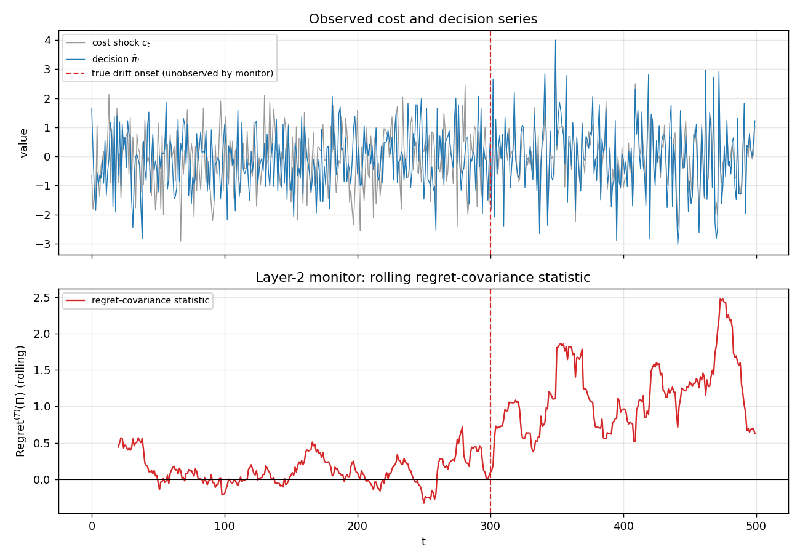
Through their proposed governance framework, the authors highlight the importance of real-time monitoring, particularly for systems governed by vendor models. Using tools like the regret-covariance statistic, institutions can gauge how far an AI has deviated from its anticipated behavior, essentially enhancing their oversight capabilities without needing direct access to internal model parameters.
Implementation: A 90-Day Roadmap
The journey towards establishing a robust governance structure doesn’t need to be daunting. Aldridge and Krawciw have outlined a pragmatic 90-day implementation plan that involves:
- Days 1–30: Inventory existing agentic systems and document vendor model identifiers.
- Days 31–60: Implement policy stability monitoring and establish kill-switch architectures.
- Days 61–90: Review reward function governance, assess policy similarities with competitors, and present findings to upper management.
A Call for Enhanced AI Literacy in Finance
At the core of the governance gap lies an institutional challenge: a lack of technical literacy among those responsible for governing sophisticated AI systems. The research emphasizes the necessity for finance professionals to elevate their understanding of AI technologies, thus ensuring that they can effectively specify and implement the required governance frameworks.
In conclusion, as agentic AI continues to reshape the landscape of finance, the call for robust governance frameworks is clear. By embracing these new strategies and fostering a culture of AI literacy, financial institutions can fortify themselves against the profound risks associated with this transformative technology.




