
Breaking Boundaries in AI Coding: Introducing TrustedCode for Reliable Python Verification
In the evolving world of artificial intelligence and programming, the reliance on AI-generated code is surging. Reports indicate that around 30% of code contributions to GitHub are now AI-generated, mainly in Python. However, the quality and reliability of this code are often questionable. To tackle this challenge, a team from the University of Greenwich has introduced TrustedCode, an innovative framework that leverages large language models (LLMs) for formal verification of AI-generated Python code.
The Need for Formal Verification
As software complexity increases, traditional testing approaches can fall short, leading to unreliable code. Formal verification, which involves rigorous mathematical proofs to establish the correctness of software, is gaining traction as a way to enhance software trustworthiness. Despite its potential, formal verification tools have primarily focused on languages like Java and C, leaving Python developers at a disadvantage.
Introducing TrustedCode
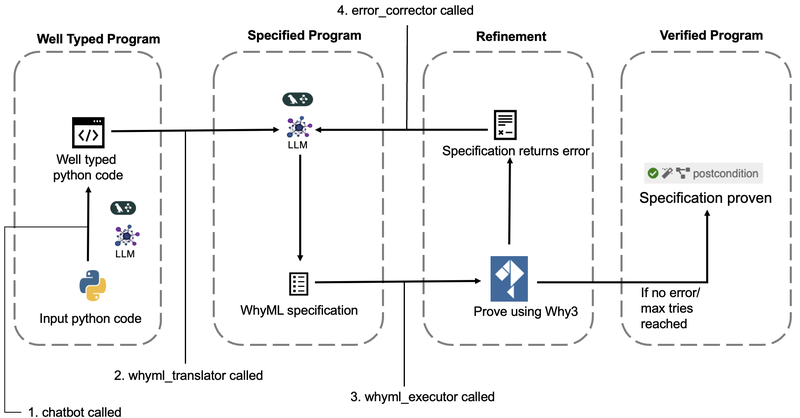
TrustedCode stands out as a groundbreaking solution designed specifically for Python. It automates the verification process of AI-generated Python code by integrating advanced LLM capabilities and formal verification techniques. The framework's workflow includes:
- Type-checking Python code for compatibility.
- Translating the code into a formal specification language known as WhyML.
- Verifying the translated code against formal specifications using automated theorem provers.
This closed-loop system ensures that the code goes through multiple correction attempts, enhancing its reliability. A key feature is the use of LangGraph, which integrates a chain-of-thought reasoning process that helps the LLM overcome its limitations in generating correct specifications and proofs.
Understanding the Results
The researchers evaluated TrustedCode's effectiveness by testing various Python programs of different complexities. Their findings indicated that:
- 50% of coding errors were related to gaps in domain knowledge.
- 30% stemmed from syntactic inaccuracies.
- 20% originated from semantic and type-related issues.
These insights highlight the necessity for ongoing improvements in LLM-guided verification processes for Python, especially as AI-generated code becomes more prevalent.
A Step Towards Open Source
The developers of TrustedCode have made it freely available as an open-source tool, encouraging further innovation and collaboration in the field. Interested developers can access the tool on GitHub and a demonstration video is available online, showcasing its capabilities in real-time.
Conclusion: Trusting AI for Coding
As AI continues to play a pivotal role in software development, ensuring the reliability of AI-generated code is essential. By merging LLMs with formal verification techniques, TrustedCode represents a significant advancement towards achieving trustworthy coding practices. This development not only benefits software developers but also enhances the overall integrity of technological solutions in our increasingly digital world.
Authors: Muhammad Danial, Muhammad Taimoor Khan


