
Breaking Boundaries: AEON Merges Video and 3D Models for Unmatched Scene Realism
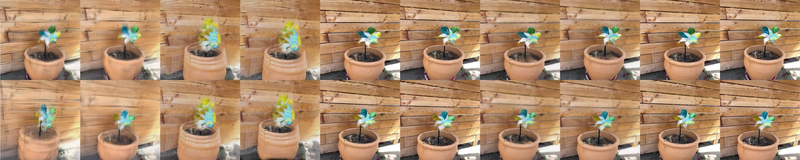
The realm of artificial intelligence has yet again been revolutionized with the introduction of AEON, a groundbreaking framework that unifies video-based and 3D-based world models. Developed by a distinguished team from Tsinghua University, AEON aims to overcome the limitations of existing models by delivering a comprehensive solution that combines the strengths of both paradigms. This innovation not only enhances the realism of simulations but also paves the way for new applications in robotics and game design.
What's the Problem?
Traditionally, world modeling has been divided into two approaches: video generative models that simulate lifelike appearances but often lack 3D consistency, and 3D generative models that create geometrically consistent environments but fall short in realistic representation. AEON tackles these shortcomings by seamlessly integrating video and 3D models, ensuring both stunning visuals and structural integrity.
The Core of AEON: 4D Gaussian Splatting
At the heart of AEON is a powerful representation called 4D Gaussian Splatting (4DGS). This groundbreaking method allows for the depiction of dynamic scenes, such as moving objects and evolving environments, while maintaining a coherent 3D structure. By employing this technique, AEON can generate scenes that look not only realistic but also behave in ways that accurately reflect real-world physics.
Technical Brilliance Simplified
The architecture revolves around a 4D Gaussian Reconstruction Model (4DRM) that utilizes depth information from monocular videos to predict both visual appearances and dynamic transformations. Imagine being able to recreate a bustling city scene where cars move fluidly and pedestrians walk realistically, all generated from mere video input!
To filter the rich data from videos, AEON implements a novel domain adapter that translates generative video latents into reconstructive 4D latents, enabling a smooth transition from simple frames to complex, explorable worlds.
What Makes This So Special?
The versatility of AEON is astonishing. From enabling detailed robotics simulations to creating immersive video games and even supporting text-to-world generation, AEON has demonstrated superior performance across various benchmarks. Users can generate 4D environments from textual descriptions or images, meaning creativity is now limited only by imagination.
Future Prospects
This innovative model opens up exciting avenues for both researchers and creators. Future enhancements could include expanding the capability to simulate larger environments or integrating even more complex interactions akin to those found in real life.
AEON not only breaks the mold of previous world modeling strategies but also sets a new benchmark for what is possible in the fascinating intersection of AI, video, and 3D environments. Expect to see AEON at the forefront of future explorations in technology, creativity, and artificial intelligence.
For those interested in diving deeper into AEON, further research and details can be found in their official project page: https://weiqi-zhang.github.io/AEON.
Authors: Weiqi Zhang, Wenyuan Zhang, Yu-Shen Liu, Junsheng Zhou


