
Breaking Barriers in Robotics: How Audio and Video Can Teach Robots to Apply the Right Force
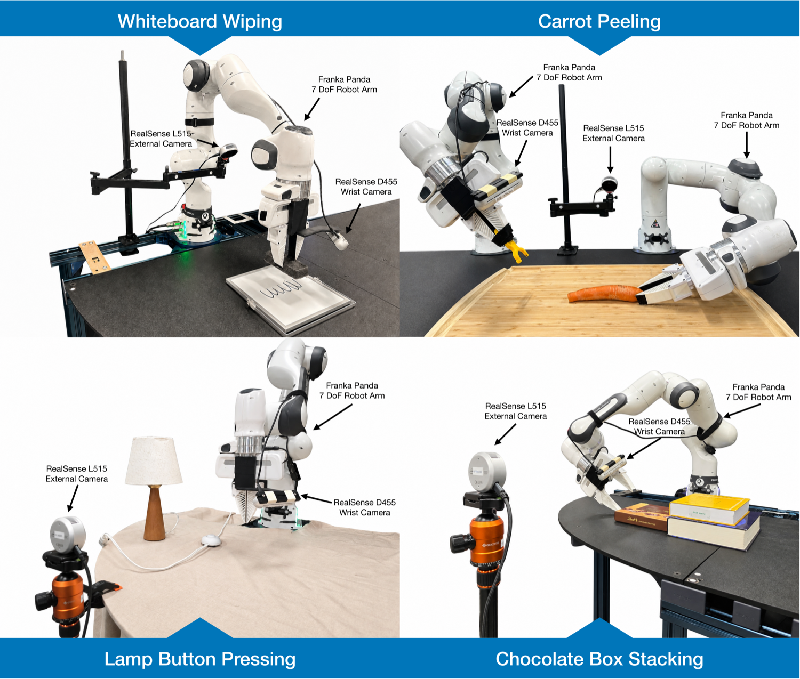
A fascinating new research paper titled "Dreaming the Sound of Contact" reveals how the combination of audio and video generation can enable robots to perform contact-rich manipulation tasks without prior physical demonstrations. The study, conducted by a team of researchers from the University of Pennsylvania, leverages the synergy between visual and auditory data to create a novel approach for robotics that could improve the performance of robots in everyday activities.
The Challenge of Force in Robotics
Until now, robots have largely depended on visual data to learn tasks like wiping surfaces or peeling vegetables. However, these purely visual approaches often overlook a critical element: the force required to achieve successful manipulation. Without force information, robots frequently struggle with contact-rich tasks that require them to apply the right amount of pressure. For example, if a robot fails to press a button correctly due to inadequate force, it may not trigger the desired action. This is where the new study steps in.
Integrating Audio as a Force-Indicator
The researchers proposed an innovative pipeline that uses generated audio from robot-centric video to shape a time-varying desired-force profile. The intensity of contact sounds generated during manipulations serves as a proxy for estimating the appropriate force that the robot should apply. By analyzing the loudness of sounds during contact, the robot can learn to modulate its force dynamically as needed throughout the task.
Successful Outcomes in Real-World Tests
The effectiveness of this new approach was put to the test on a Franka Panda robot, which executed several contact-rich tasks: wiping a whiteboard, peeling a carrot, stacking a chocolate box, and pressing a lamp button. Remarkably, the robot achieved a success rate of 90% when utilizing the force-aware trajectory generation, compared to a mere 20% under traditional kinematic-only approaches. By harnessing both audio and video data, the robot was able to learn from a zero-shot perspective—executing tasks without prior examples or force supervision.
A Step Towards Autonomous Learning
This study not only enhances robot manipulation capabilities but also opens doors for future developments in robotics. The team envisions potential applications where robots could autonomously learn and adapt to different tasks using audio feedback. By combining advancements in generative modeling with real-time data processing, robots could refine their skills in various environments, essentially evolving their capabilities over time.
With this research paving the way for intelligent robots that understand not only what to do, but also how much force to apply when doing it, we find ourselves closer to a future where robots can assist us in a multitude of complex tasks in our daily lives, from cooking in the kitchen to performing delicate surgeries.
For further details about the research, you can check the project website at Dreaming Contact.
Authors: Guanhua Ji, Tianyu Li, Dayoon Suh, Yuqian Zhang, Boyan Zhang, Nadia Figueroa




