
Breaking Barriers in Connected Vehicle Safety: How NS3Learn Enhances 5G NR Mode-2 Reception for Real-World Impacts
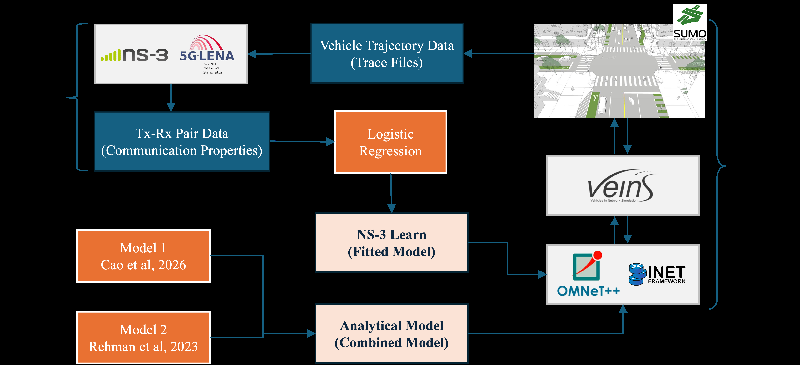
In an era where vehicle connectivity is paramount for safety and efficiency, the latest research introduces NS3Learn, an innovative model that drastically improves the reliability of 5G New Radio (NR) communications in connected vehicles. This groundbreaking research, led by Rasheed Bello and colleagues, addresses a critical gap in vehicular safety studies, enhancing the accuracy of how we assess communication loss in dense traffic situations.
The Need for Realism in Connected-Vehicle Studies
Connected vehicles rely on timely data exchange for safety applications. Yet, traditional simulation models often fall short, returning falsely optimistic results about message delivery, particularly in congested urban areas. Common models failed to account for the intense competition for radio resources—a major source of message loss in real-world scenarios. This is where NS3Learn comes in, providing a more realistic assessment of communication failures through innovative labeling and modeling techniques.
What NS3Learn Brings to the Table
The NS3Learn model distills reception behavior from ns-3’s advanced 5G simulation, quantifying how vehicles experience message losses due to interference and contention for resources. By analyzing over 10 million data points from simulated vehicular interactions, researchers developed a cascade model that tracks various loss mechanisms, such as short transmission periods when vehicles cannot listen for messages simultaneously, and collisions when vehicles inadvertently pick the same communication resources.
By focusing on these critical factors, NS3Learn delivers a mean absolute deviation of only 0.06 in its predictions, significantly outperforming existing analytical alternatives that deviate by larger margins. This translates to more accurate simulations that can be trusted by agencies and researchers.
Significance of Results
The implications of this research extend beyond academic interest. With NS3Learn, municipalities and traffic safety agencies can leverage existing simulation pipelines to explore the real-world efficacy of connected vehicles in various traffic scenarios. In practice, this means being able to accurately represent the losses that impede network reliability, thereby informing better deployment strategies for connected vehicle technologies.
Moreover, the research highlights how the reception model can impact driving behavior. In scenarios simulated with NS3Learn, the model leads to more cautious driving outcomes, with a doubling of hard braking incidents compared to previous models. This underscores the vital connection between communication realism and the effective functioning of safety protocols in vehicles.
Future Directions
The work on NS3Learn sets the stage for future explorations into vehicle-to-everything (V2X) communication. The ability to adapt this model for different vehicles and scenarios makes it a powerful tool for ongoing research into intelligent transportation systems. Furthermore, the proposed methodology offers a template that can be applied across varying radio configurations and environments, promising widespread applicability.
As connected vehicles continue to reshape the transportation landscape, research like NS3Learn is essential for ensuring that the underlying communication systems are robust and reliable. With enhanced models, safety assessments can evolve, ultimately leading to smarter, safer driving experiences for all.
Authors: Rasheed Bello, Arthur Mukwaya, Gurcan Comert, Varghese Vaidyan, Vijay Bendigeri, Anthony Dontoh, Sahoo Jagruti, Judith Mwakalonge.




