
Beyond Emojis: How New Research Redefines Emotional Expression in Tweets
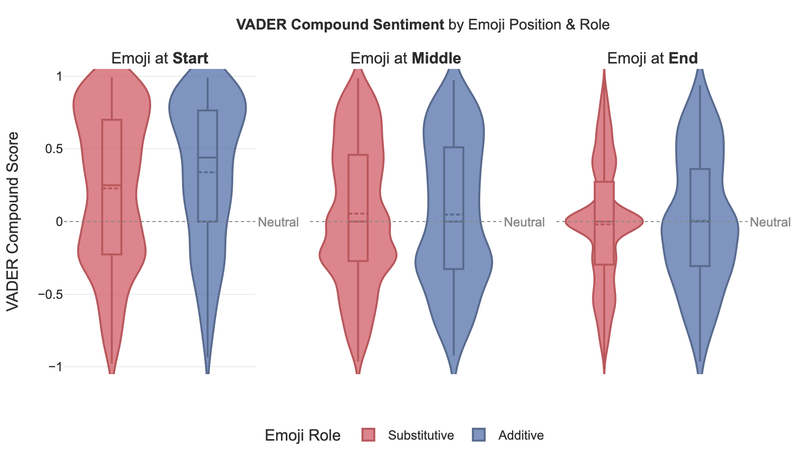
In the world of social media communication, emojis have become indispensable tools for conveying emotion and nuance. However, a groundbreaking study from researchers at Trinity College Dublin challenges the long-held belief that emojis can be encapsulated by a single sentiment score. This research, which analyzed over 16,000 tweets, reveals that emojis function on multiple dimensions—topical coherence and emotional variance—indicating a more complex role in digital communication than previously understood.
The Complexity of Emoji Meaning
Traditionally, many analyses of emoji rely on the assumption that they represent a fixed emotional state, typically quantified through a simple sentiment score. The new research introduces a concept called "stability delta," which measures how contextually consistent an emoji is when appearing alongside text. This approach reveals that emojis tend to evoke a wider range of emotional responses when they are used in more thematically consistent contexts, contrary to prior beliefs that such usage would limit emotional expression.
Key Findings and Implications
The study uncovers that emojis used in tightly clustered topical contexts show more polarised emotional responses. Specifically, the researchers found a positive correlation between the stability delta of an emoji and higher emotional variance in responses from crowdsourced sentiment ratings. This suggests that when an emoji is contextually grounded—used alongside thematically consistent text—it tends to invoke a broader spectrum of feelings among users.
As an example, emojis like the "collision" emoji demonstrated high stability delta, indicating their prominent role in specific, affect-rich contexts, such as dramatic announcements. On the flip side, emojis like the "angry face," with a low stability delta, illustrate their use across diverse contexts that dilute their emotional impact.
Implications for Emotion-based Technologies
This research carries profound implications for fields like affective computing and sentiment analysis, suggesting that technologies built on single sentiment scores could misinterpret nuanced online conversations. The authors advocate for future applications to consider these dual dimensions of emoji meaning—topical coherence and emotional depth—to design more effective communication tools, sentiment analysis systems, and social media moderation frameworks.
The findings call into question the binary approach that has dominated emoji sentiment classification, urging a reevaluation of how emojis are interpreted across different contexts, platforms, and cultures. As we continue to rely on emojis for digital expression, the study underscores the importance of understanding the complex layers of communication in the emoji-infused language of social media.
Ultimately, this study offers a significant leap forward in our understanding of digital communication, paving the way for future research that could further explore the implications of emoji usage in various linguistic environments.
Authors: Rohan James, Ioannis Christofilogiannis, Yuuv Jauhari, Shreya Shah, and Gauri Pethkar


