
AI-RAN Revolution: How Workload-Aware Monitoring is Setting a New Standard for Radio Networks
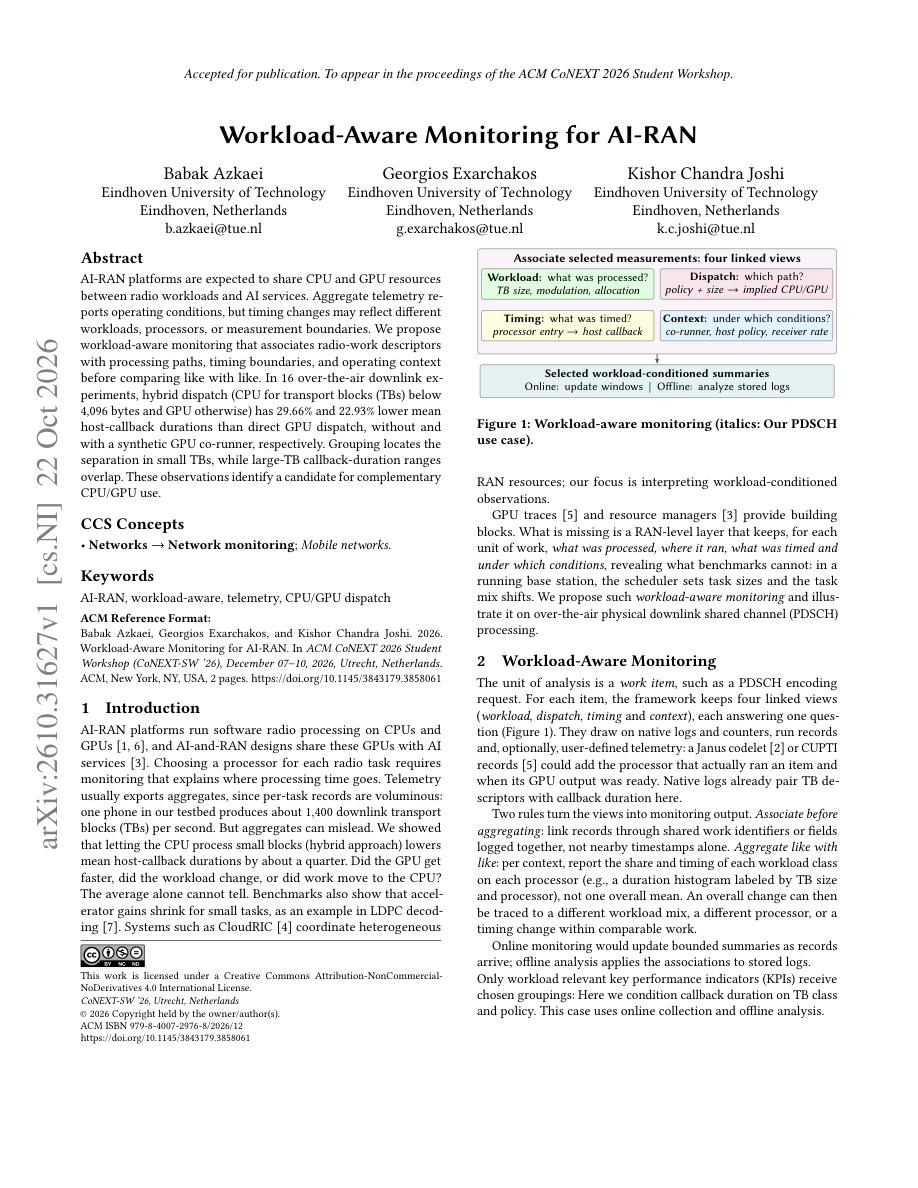
The landscape of radio access networks (RAN) is evolving rapidly, spurred by the integration of artificial intelligence (AI) and advanced processing technologies. A groundbreaking research paper titled "Workload-Aware Monitoring for AI-RAN," authored by Babak Azkaei, Georgios Exarchakos, and Kishor Chandra Joshi from the Eindhoven University of Technology, unveils innovative monitoring techniques designed to optimize CPU and GPU resource sharing in AI-RAN platforms.
Understanding Workload-Aware Monitoring
In simple terms, as AI applications grow in complexity, they need to effectively share computing resources with traditional radio workloads. The research introduces a concept called workload-aware monitoring, which can track and analyze how and where processing time is spent within a network, leading to more efficient use of resources.
The researchers point out that conventional telemetry methods often provide aggregate data that can mask critical details about performance fluctuations. Their proposed method captures specific work items, like individual data transport requests, and effectively analyzes them based on four critical factors: what was processed, which processor was employed, the timing of operations, and the operating context. This detailed monitoring allows for precise comparisons and adjustments to processing strategies.
Impressive Findings from Real-World Testing
Through a series of experiments, the researchers found compelling results regarding the hybrid approach to dispatching tasks—utilizing CPUs for smaller data blocks while allocating larger ones to GPUs. They reported a significant reduction in processing time: a hybrid dispatch method resulted in 29.66% and 22.93% lower host callback durations compared to a purely GPU-based approach, regardless of whether a synthetic GPU co-runner was present. This insight is vital for maximizing performance while mitigating resource bottlenecks.
The Future of AI-RAN Monitoring
Looking ahead, the implications of this research extend beyond immediate processing benefits. The workload-aware monitoring framework is slated to adapt dynamically based on current load conditions, making it an integral part of future network architectures. This adaptability will enable more effective collaboration between AI tasks and radio processing, ultimately enhancing the performance of communication networks.
As the demand for faster, more reliable mobile and network services continues to rise, the introduction of such robust monitoring systems is poised to redefine how we manage and optimize network resources. The work of Azkaei, Exarchakos, and Joshi marks a significant step forward in ensuring that next-generation AI-infused radio technologies can meet the ever-growing expectations of users worldwide.
For more details, this research is set to be presented at the ACM CoNEXT 2026 Student Workshop, adding to the growing discourse on AI and networking technologies.


