
The Untold Journey of Mathematics: From Ancient Sands to Modern Marvels!
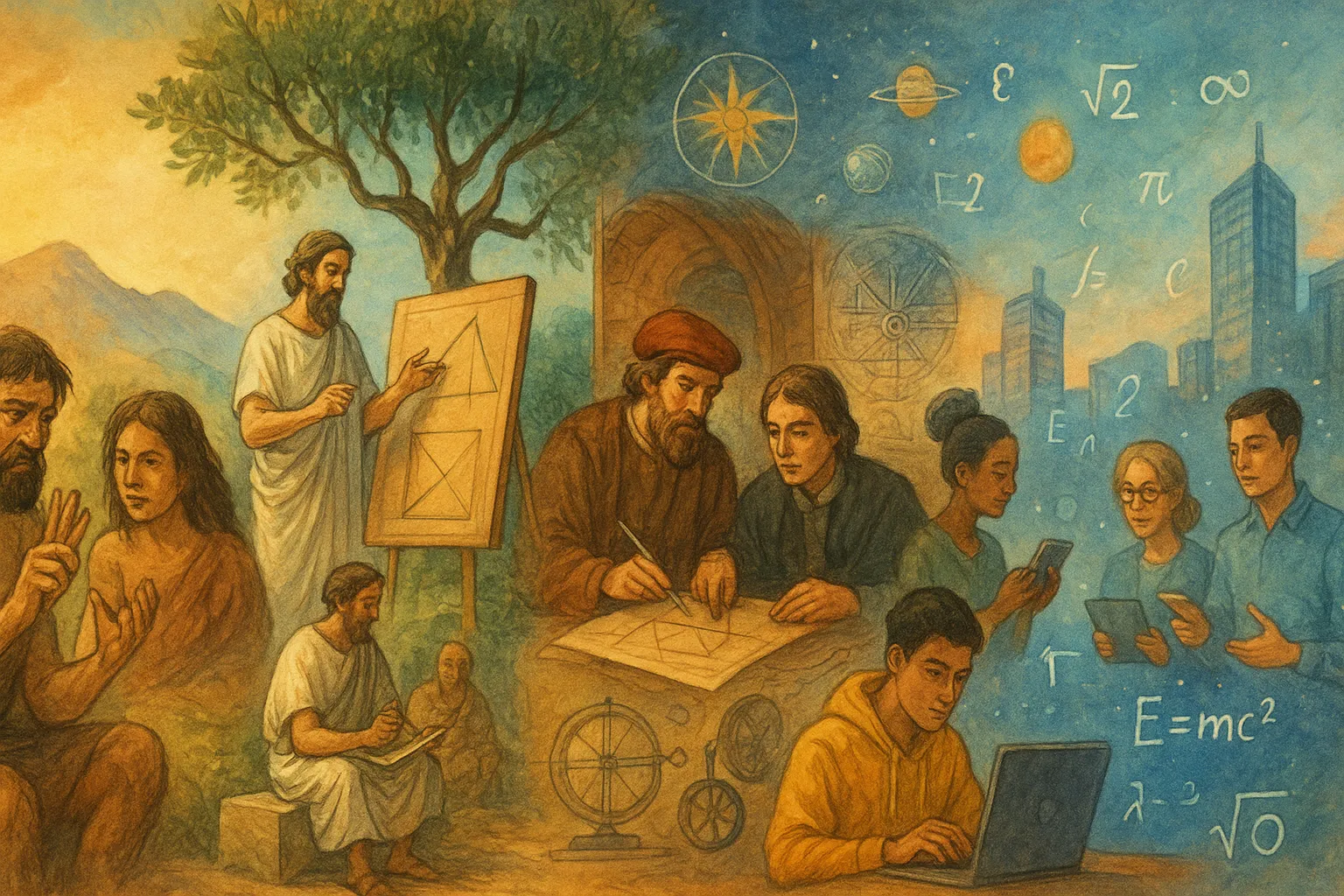
Mathematics is often perceived as a dry subject filled with numbers and formulas, but its history is rich with human experience, innovation, and intrigue. From the early days of counting on fingers to the advent of quantum computing, the story of mathematics is also the story of mankind's quest for understanding the universe. This article will take you on a journey through time, exploring how mathematics evolved and why it remains indispensable in our everyday lives.
Counting on Fingers: The Dawn of Numbers
The story of mathematics begins in the cradle of civilization. Ancient cultures needed to keep track of livestock, harvests, and trades, leading to the first systems of counting. The earliest known mathematics can be traced back to the ancient Sumerians around 3000 BC, who developed a base-60 number system, which is why we still use 60 seconds in a minute and 360 degrees in a circle today. Imagine life without these simple measures; it would be a lot more chaotic!
Geometric Genius: Ancient Greeks and the Birth of Formal Theory
Fast forward to the ancient Greeks, who transformed mathematics into a formal discipline. Figures like Euclid and Pythagoras developed logical proofs and theorems, laying the groundwork for what we now refer to as geometry. A fascinating fact is that during this time, mathematics was not just a study of numbers but also intertwined with philosophy, creating a lens through which scholars sought to understand existence itself. Can you picture a world where discovering mathematical truths was akin to exploring the depths of human thought?
The Age of Enlightenment: Mathematics Meets Science
As the Renaissance dawned, mathematics found itself deeply intertwined with science. Thinkers like Isaac Newton and Gottfried Wilhelm Leibniz applied mathematical principles to physics, leading to groundbreaking discoveries in calculus. This integration not only advanced science but also propelled advancements in engineering, navigation, and even economics. The story of mathematics here becomes one of necessity; in a rapidly changing world, the quest for accuracy and innovation became central to progress.
Modern Math: An Infinite Open Door
Today, mathematics has branched out into numerous fields, from statistics to abstract algebra and from cryptography to data science. The invention of computers revolutionized the field, bringing forth complex algorithms that solve real-world problems—from predicting weather patterns to encrypting sensitive data. Did you know that math is at the heart of artificial intelligence? Each time you interact with a smart device, you're touching the fruits of centuries of mathematical evolution. Isn’t it mind-boggling how these abstract concepts come to life in our daily routines?
Why Mathematics Matters Today
So, why should anyone care about the history of mathematics? The answer is simple: it shapes our world. Understanding its history gives us context; it transforms mathematics from a mere collection of formulas into a breathtaking journey through human ingenuity. The patterns and concepts developed throughout history continue to impact our decisions, technology, and even the arts. Furthermore, as we face global challenges, mathematics plays a critical role in data analysis and modeling, helping us navigate issues like climate change and public health.
Conclusion: A Timeless Legacy
In conclusion, the history of mathematics is not merely a chronicle of numbers and equations; it's a testament to humanity's relentless pursuit of knowledge. As we stand on the shoulders of giants—those who shaped our understanding of the world—let us remember that every mathematical concept we encounter today is part of an ongoing story. Mathematics is not just a tool for engineers and scientists; it's a universal language that transcends cultures and time. So, the next time you use math in your daily life, take a moment to appreciate the rich history that has made it possible.




