
Gravity's Dance: How Einstein's Relativity Theory Unveils the Secrets of Our Universe
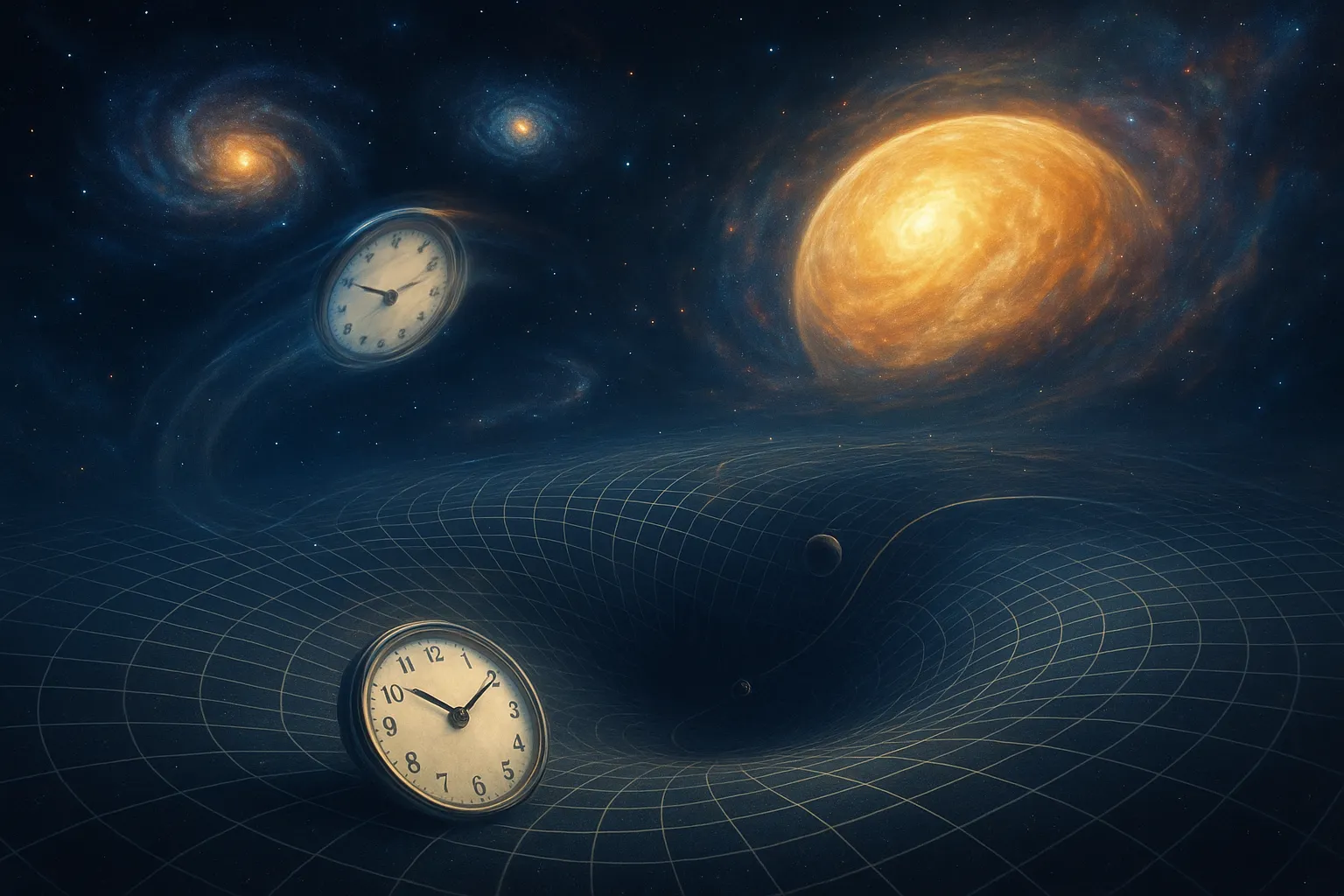
Imagine a universe where time isn't the constant we think it is, and gravity isn't just a force pulling us to the ground, but a warp in the fabric of space itself. Welcome to the fascinating world of relativity, a groundbreaking theory introduced by Albert Einstein over a century ago. Despite its complexity, relativity has incredible implications for how we understand the universe and our place within it. Let’s break it down in a way that everyone can grasp!
The Basics of Relativity
Einstein's theory of relativity comes in two parts: special relativity and general relativity. Special relativity, published in 1905, revolutionized our understanding of time and space. It introduced the idea that the laws of physics are the same for all observers, regardless of their relative motion. A crucial takeaway is that the speed of light is constant—no matter how fast you’re moving, light will always travel at the same speed.
Now, what does this mean for us? Think of it this way: if you could travel at nearly the speed of light, time for you would slow down in comparison to those who remained at rest. This mind-boggling effect is known as time dilation and has been proven through experiments with atomic clocks on airplanes. Yes, this means that flying around the world can actually age you a little less than your friends who stayed home!
General Relativity: Bending Space and Time
Einstein didn't stop at special relativity. In 1915, he introduced general relativity, which built on his earlier ideas but added gravity into the mix. Essentially, Einstein proposed that massive objects like planets and stars create 'dents' in the fabric of space-time, causing other objects to move along curved paths. This is why planets orbit stars and why we experience gravity.
To illustrate this, picture a trampoline with a heavy bowling ball placed at its center. The fabric stretches and forms a dip around the ball. If you then roll a marble nearby, it spirals towards the bowling ball along the curve created by the dent. This analogy helps to visualize how celestial bodies interact through gravity, a quality that traditional Newtonian physics didn't capture as fully.
Real-World Applications: More Than Just Theory
You might be wondering, “Why does this matter?” The principles of relativity are not just theoretical curiosities—they impact our daily lives! For instance, the technology behind GPS relies on both special and general relativity. GPS satellites orbit Earth at high speeds and experience less gravity than people on the ground, which leads to discrepancies in time between satellites and Earth. Without adjusting for these differences, our navigation systems would quickly become inaccurate.
Additionally, scientists studying phenomena such as black holes, gravitational waves, and even the expansion of the universe rely heavily on relativity to formulate their theories and conduct experiments. Just recently, the detection of gravitational waves confirmed a prediction made by Einstein a century earlier, showcasing how interconnected our understanding of the universe truly is.
Wrapping It Up: The Ongoing Legacy of Relativity
Einstein's relativity theories not only reshaped the narrative of classical physics but also propelled humanity into an age of cosmic exploration and understanding. By embracing the complexities of time and space, we find ourselves more connected to the universe than ever before. So, the next time you glance up at the stars, remember: you're looking at a splendid tapestry woven together by the very principles that Einstein so brilliantly revealed.




